
Patient News
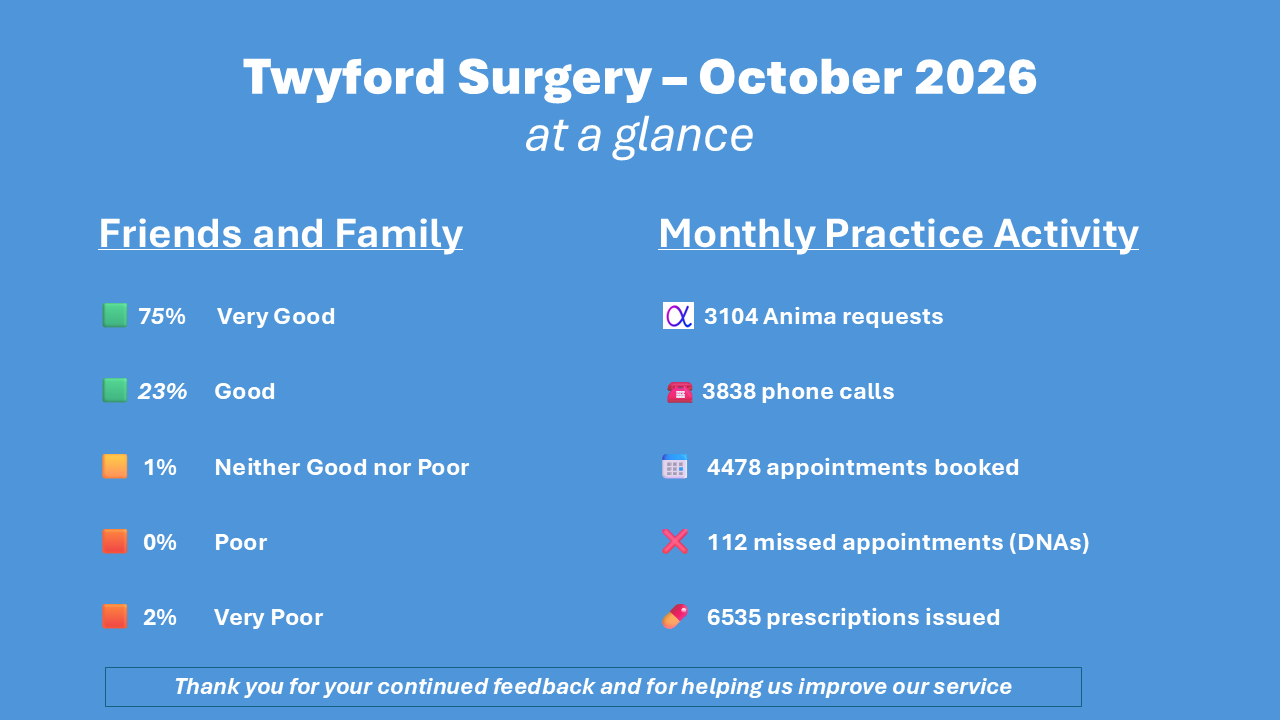
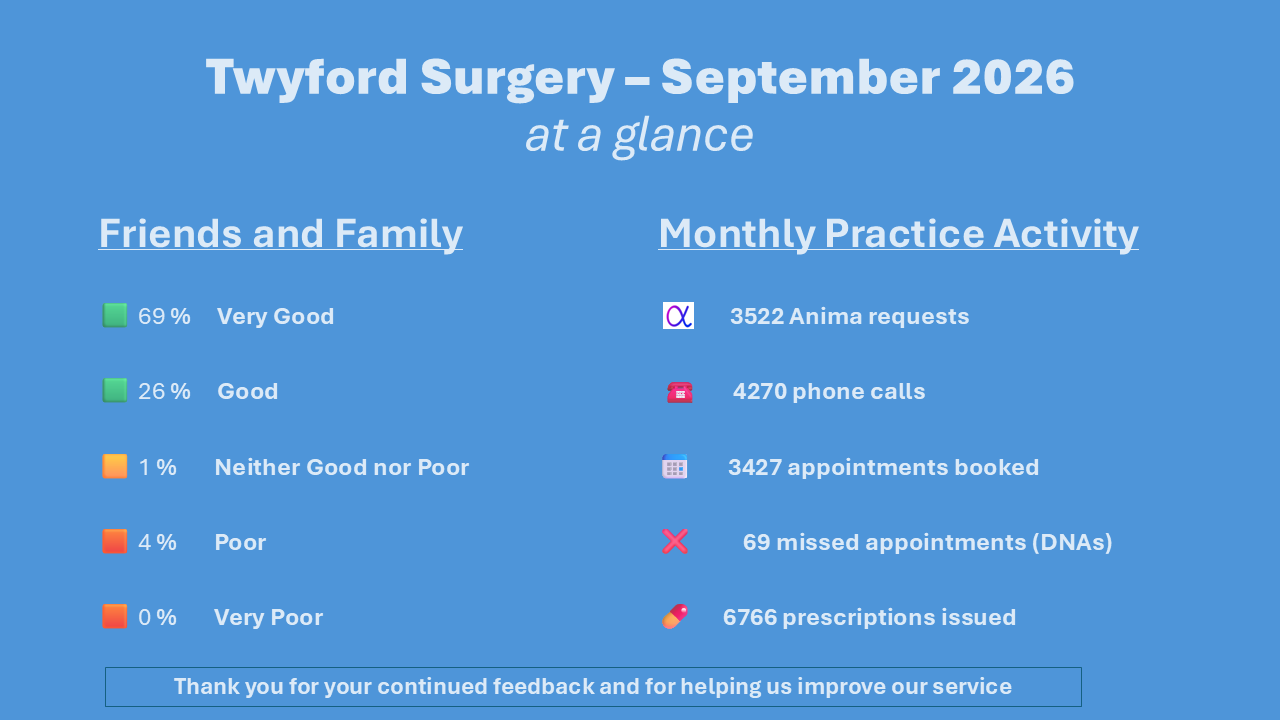
We wanted to update you on our trial of Andi, our automated telephone assistant.
When we introduced changes to our telephone system in July/August, we explained that Andi would be used on a trial basis while we assessed how well it worked for both patients and the practice.
Thank you for your patience while we tested this technology. Following a review of the trial and the feedback received, we can confirm that Andi has now been switched off.
We hope you understand that, with increasing demand for NHS services and ongoing pressure on resources, it was important for us to explore new ways of managing patient contact. Our reception team continue to do an incredible job, and we are extremely grateful for their hard work and dedication in responding to the high volume of calls and enquiries we receive each day.
As a result, telephone queues may be longer again. However, many of you told us that you would rather wait and speak directly to a member of our team, and we have listened to that feedback.
In short, we agree that Andi was not the right solution for our practice at this time.
As always, if you are able to do so, you can submit an online request through Anima without needing to telephone the practice.
You can also find a wide range of information on our website, including answers to common queries and details of our practice policies.
Thank you for your continued support and understanding.
At Twyford Surgery we are now registered with the Research and Surveillance Centre (RSC). We are specifically taking part in viral disease surveillance at present.
If you have symptoms of an upper respiratory tract infection such a new cough, runny nose, sneezing or sore throat you can help with this important work.
You can order a self-swabbing kit from home via the following steps:
- Visit https://takeatestuk.com
- Enter voucher code K81070
- Follow the questions and enter your details – you are eligible if your symptoms started within the last 4 days which appears to be the case from your medical request today.
- Complete the swabs once received in the post as per the instructions. One for both nostrils and one for the back of the throat.
- Return the sample via the post in the prepaid envelope. Samples do not need to be returned to us at Twyford Surgery.
- You will be emailed or receive a test result via text message.
You may also be asked by one of our staff members to provide a nose and throat swab during an appointment if you appear to have relevant symptoms and have had them for 7 days or less. If this is the case, we will take this and process the swabs for you in surgery. You will be notified by us of the result within a few days.
WHY ARE WE ASKING YOU TO DO THIS?
What is disease surveillance?
Disease surveillance involves taking virology swabs from volunteer patients to help us
to monitor respiratory viruses circulating in the community and to support vaccine
effectiveness.
What is virology surveillance?
Virology surveillance is a programme to measure the effectiveness of the influenza/flu,
RSV, and COVID-19 vaccinations using results from swabs taken by patients who are
unwell. The swabs are used to monitor the spread of several respiratory viruses, like
influenza (flu), respiratory syncytial virus (RSV), and SARS-CoV-2 (COVID-19), in
different regions throughout the winter.
Why are we conducting virology surveillance?
The anticipated burden of flu, RSV and COVID-19 during winter season on the National
Health Service (NHS) is significant. By providing this swab, you are enabling public
health bodies to make crucial public health decisions.
What is the Oxford-RCGP RSC?
The Oxford-RCGP RSC is a University of Oxford based group that oversees a network of general practices who share their infectious diseases data. Sharing this data plays an important role in public health monitoring and response to infectious diseases. This in turn impacts on policy decisions and vaccination programmes in the UK. The data may also be used for health research.
You can access the Oxford-RCGP RSC website here:
Information for Patients — ORCHID
For those who are interested, you can see latest data on circulating virsues here – by taking part we are helping to impact this important information!
Practice Dashboards and Observatories — ORCHID
What about data protection?
The data collected is “pseudonymised”. This means personal details that can identify you are removed and replaced with a code number, and that only a portion of your information is used e.g. only the month and year of your birth date is shared.
Some details are never shared e.g. your name, phone number, email address, address or day of birth.
Your data is stored securely in a University of Oxford database called ORCHID. The ORCHID database complies with UK GDPR and Data Protection Legislation to keep data secure.
For more details, please read the https://orchid.phc.ox.ac.uk/privacy-policy
Why is this data collected?
The data collected about diseases are shared with the UK Health Security Agency (UKHSA). UKHSA is the government body that monitors public health in the UK. This data helps the government to identify disease outbreaks and assess how well vaccines are working. This helps to ensure that the NHS is ready to meet patient needs. We may invite you to take part in virology or serology (blood) sampling.
How does this affect me?
Sharing data helps UKHSA and researchers better understand diseases and health conditions. This helps to develop new ways of predicting or diagnosing illness, and identify ways to improve clinical care. Sharing pseudonymised data does not affect your care or privacy.
However, if you do not want your data to be shared please read this information or talk to us.
What about health research?
The Oxford-RCGP RSC take part in approved health research. This research is vital to understand how disease spreads, and about patient health and NHS services. We may invite you to take part in health research studies.
Useful Contact details
For queries relating to the Oxford RCGP-RSC and data sharing, please contact: practiceenquiries@phc.ox.ac.uk
For queries relating to your sample, please contact us at Twyford Surgery.

As we have now fully entered into the month of August, as a training practice we now take part in the annual resident doctor change over. Up and down the country newly qualified doctors will be starting their first jobs and we wish them all well in this exciting step in their careers. Of course we hope they end up choosing General Practice as their chosen end point in the years to come!
In the meantime we have our own Resident doctor changes to share:
Dr Nair has now qualified as a full GP (with flying colours!) and we are delighted to say that she will be joining us on a permanent basis in September after a well-earned break.
Taking over from her in the training position is Dr Caitlin Kemp.
Dr Kemp has worked locally at the Royal Berkshire and Wexham Park hospitals and has 3 years experience as a doctor. She is a keen sportsperson and a talented footballer - playing for the GB Medical team whom recently competed in the Euros in Spain! Dr Kemp will be with us for 12 months and will be supervised by Dr Agarwal.
We hope you join us in congratulating Dr Nair, and welcoming Dr Kemp to the team.
We’re trialling something new!
From 5th August 2026, we will be trialling a new system called Andi, to help improve how we manage patient requests and phone calls. Andi has been created by the same team behind Anima, which we already use for online triage, and it will link directly to this.
What is Anima?
A clinical triage system that we use to generate and assist with daily triage of medical and administrative requests. This allows us to gather clinical information to match the request to the best clinical appointment type or administrative outcome.
What is Andi?
Need help from a GP, Advanced Practitioner or Nurse?
When you choose the appointment option on our phone system, instead of waiting in a call queue, you'll meet Andi, an automated system, immediately.
Andi will take your request and send it to the triage team quickly and efficiently.
Andi isn't a robotic sounding voice — he sounds quite natural. He’s been tried by our Patient Participation Group who have provided feedback and were quite impressed!
Any questions? Speak to our team at reception, or why not try it out?
You can call the test number on +442046202662 to see what Andi sounds like and get used to it before you need it.
Benefits for You:
-No more long call queues, especially at busy times like 8am
-Your query is sent straight to the right team
Benefits for the surgery:
-Helps us manage requests more efficiently
-Reduces waiting times and phone line pressure
-Frees up staff time to focus on patient care
This change will help free up our receptionists’ time, and you’ll see some changes in the surgery over the next month or so – we know that the push for digital access by NHS England can feel daunting and needs to be balanced for all.
We remain committed to providing access to the Surgery for all patients. We are delighted to confirm that’s why we’re creating a quiet room in the reception area which will allow those who cannot phone or submit an online request to be taken through their queries and a request submitted on their behalf by reception in a safe and confidential space.
A quick note:
This may feel a bit unusual at first, but rest assured, we will be monitoring how it is working for everyone. We'd love to hear your feedback as we trial this new service.
If it doesn’t work – from the patient side or from our perspective with managing the daily workflow, we will revert back.
We know some people can feel worried about such a change, but we hope the following is reassuring:
"I didn't want to speak to a robot"
We understand. You can always press to speak to a receptionist. Most patients find Andi straightforward once they've tried it — 86% of patients state they would use it again *based on internal Anima Health Research (Anima | AI Receptionist)
"Is my information safe?"
Yes! Andi is part of the same Anima health platform we already use. All data is stored securely and reviewed by your clinical team and no one else. Anima is an NHS approved platform with the right data protection compliance. We wouldn’t use it if it was not compliant or safe.
"What if it gets my request wrong?"
A clinician reviews every request before any action is taken. Nothing is automated end-to-end. If the clinician requires more information, someone will contact you. If you ever feel unsure with the outcome of a request, let us know via reception.
“I speak English as a second language, will Andi understand me?”
Yes – Andi is fluent in 45 languages, so we hope this might even help you get the right care first time.
To date, 3 students’ resident in Reading have been diagnosed in the past week with meningitis or sepsis likely to be caused by meningococcal bacteria. The age range of cases so far is 14-18 years. Sadly, one of the individuals has died.
Suspected Cases
Rapid admission to hospital is the highest priority when Invasive Meningococcal Disease (IMD) is suspected.
Contacts
Close contacts of confirmed or probable cases (as defined in UKHSA meningococcal disease guidance) are being identified and contacted by UKHSA.
UKHSA will contact GPs if a patient registered with them requires antibiotic prophylaxis.
A small cohort of students at Henley College students have also been recommended to have antibiotic prophylaxis and Men B vaccination which is being arranged in the college. Eligible students have received a letter to inform them about the recommendation.GP practices and emergency departments may be approached by some of these students with an invitation letter; these students can be offered antibiotic prophylaxis by the practice.
Regarding access to the MenB vaccine for your child not within current national vaccination programme eligibility criteria, the vaccine can be provided via private providers, as changes have not been made to the current schedule.
Parents may wish to check their child’s vaccination status. This can be done through checking their child’s red book or viewing details on the NHS App.
Further information for members of the public, patients and families is also available from the following websites: NHS (Meningitis - NHS, UKHSA: https://www.gov.uk/government/publications/meningococcal-disease-guidance-on-public-health-management or the meningitis charities: www.meningitis.org and www.meningitisnow.org .
Signs and symptoms of meningococcal disease (Meningitis and septicaemia) are detailed below. It is important to seek urgent medical attention if there are any symptoms.
Symptoms of meningitis
Symptoms of meningitis develop suddenly and can include:
- a high temperature (fever)
- being sick
- diarrhoea
- a headache
- a rash that does not fade when a glass is rolled over it (but a rash will not always develop)
- a stiff neck
- a dislike of bright lights
- drowsiness or unresponsiveness
- seizures (fits)
These symptoms can appear in any order. You do not always get all the symptoms.
When to get medical help
Call 999 for an ambulance or go to your nearest A&E immediately if you think you or someone you look after could have meningitis or sepsis.
Trust your instincts and do not wait for all the symptoms to appear or until a rash develops. Someone with meningitis or sepsis can become very unwell very quickly.
If you're not sure if your symptoms are serious, use NHS 111 online or call 111 to find out what to do.
If you've had medical advice and are still worried or any symptoms get worse, get medical help again.
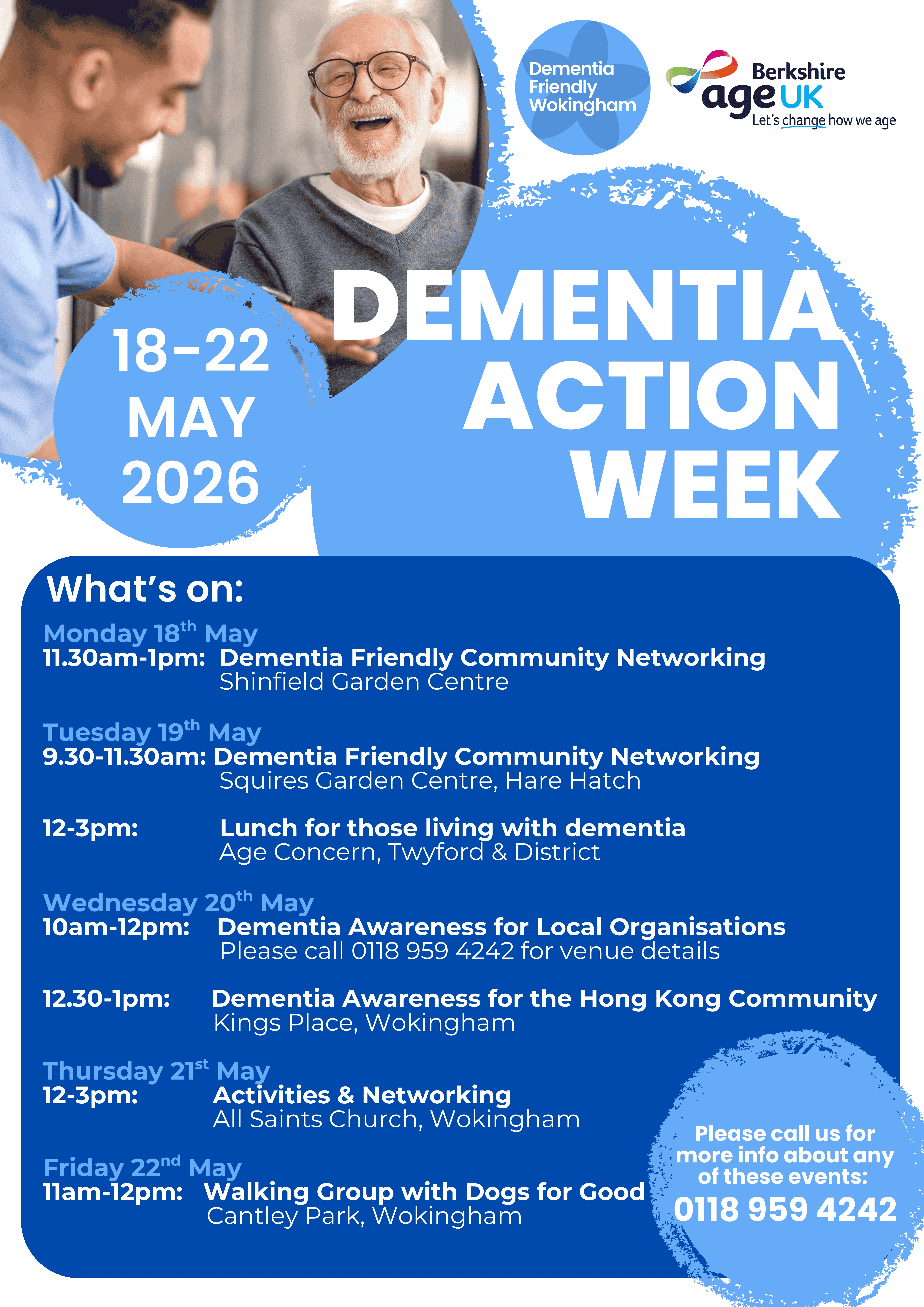
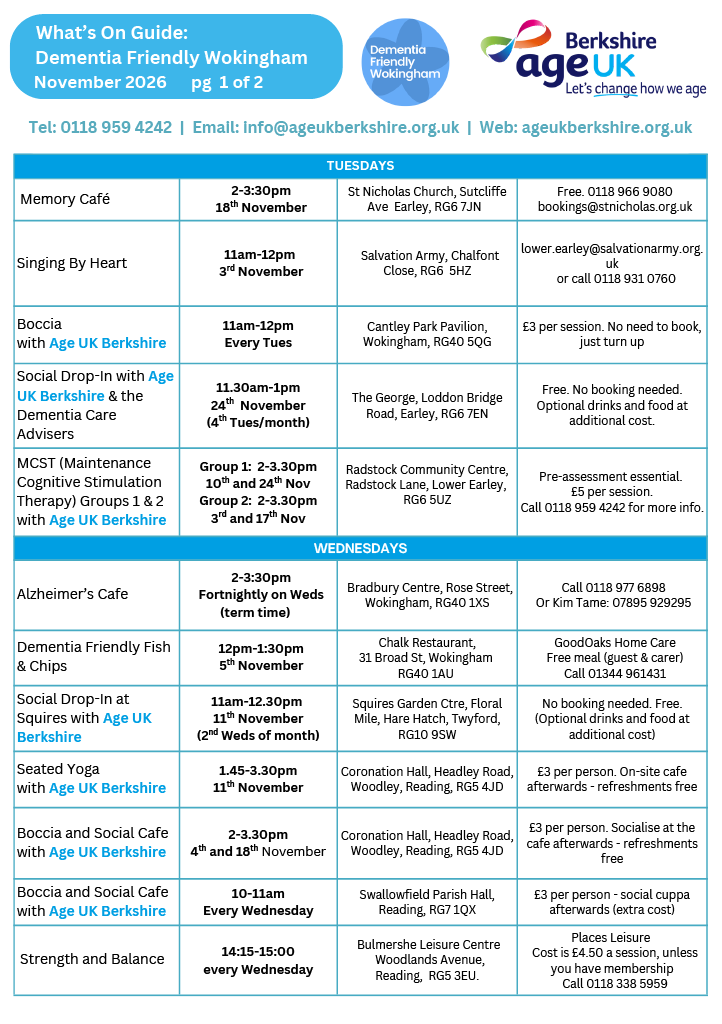
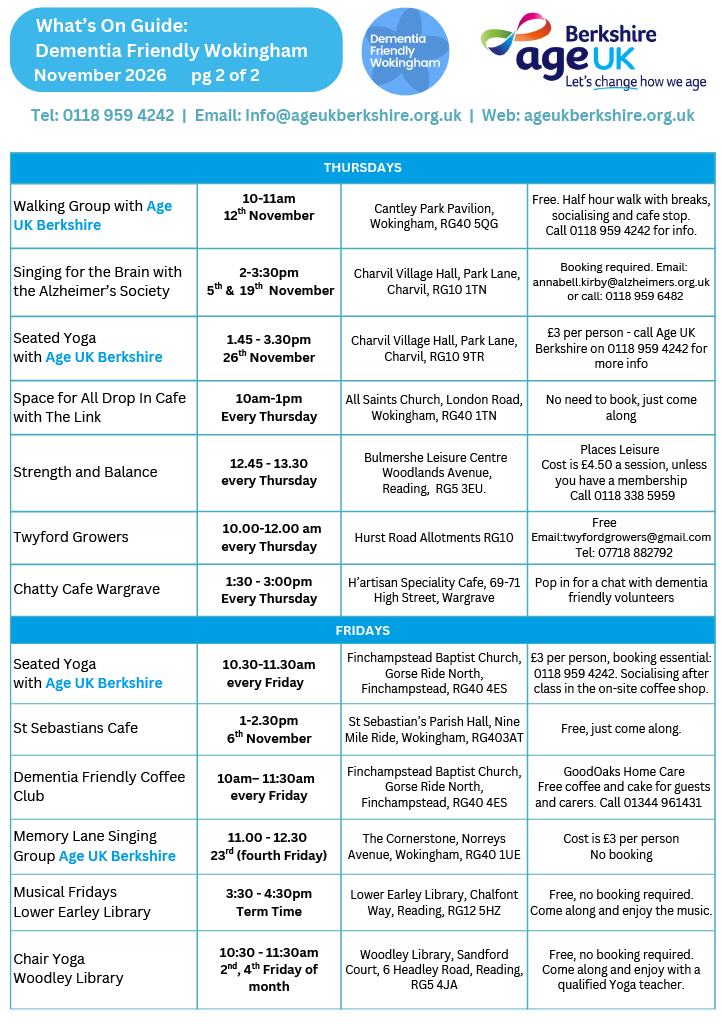
Next week is Dementia Action Week and there are lots of things happening across the Wokingham area for those with dementia and their families or carers. It's also a great chance for anyone to find out more about dementia.
Take a look at the events and actiivities Age UK Berkshire have planned.
Next week is Dementia Action Week and there are lots of things happening across the Wokingham area for those with dementia and their families or carers. It's also a great chance for anyone to find out more about dementia.
Take a look at the events and actiivities Age UK Berkshire have planned.
Information for parents
Please note we are currently experiencing high volumes of calls and emails.
What’s happening?
- There is a meningococcal disease outbreak in Kent.
- UKHSA is working to contain the outbreak and is giving prophylaxis antibiotics to close contacts.
- No new advice has been issued about accessing the MenB vaccine for the wider public.
Who decides vaccine recommendations?
- All vaccine recommendations in the UK are monitored and decided by the Joint Committee on Vaccination and Immunisation (JCVI).
- The JCVI reviews all cases of vaccine-preventable disease, national data, and emerging risks.
- Currently, there are no plans to offer MenB vaccine outside of the routine infant schedule.
What protection does my child already have?
- Children receive Hib/MenC at 1 year of age, which provides early protection.
- In Year 9, young people are offered the MenACWY vaccine.
- MenACWY provides protection during the later school years and into college/university, where risk is higher.
- This means most secondary-aged children already have strong protection against the meningococcal strains of greatest concern in teens and young adults.
Check your child’s vaccine history
You can check your child’s vaccination record by:
- Looking in your child’s Red Book
- Checking your child’s NHS App
- If your child is secondary school age, you can contact the Immunisation Team:
West Berkshire: westschoolimms@berkshire.nhs.uk
Routine vaccines to stay protected
Make sure your child is up to date with:
- MenACWY (Year 9)
- Td/IPV booster (Year 9)
Full vaccine schedule:
www.nhs.uk/vaccinations/nhs-vaccinations-and-when-to-have-them
Know the symptoms of Meningitis
Seek urgent medical help if you notice:
- Rash that doesn’t fade with pressure
- High fever
- Severe headache
- Stiff neck
- Vomiting
- Cold hands or feet
- Confusion
Reduce the risk
- Wash hands regularly
- Don’t share drinks, vapes, or cigarettes
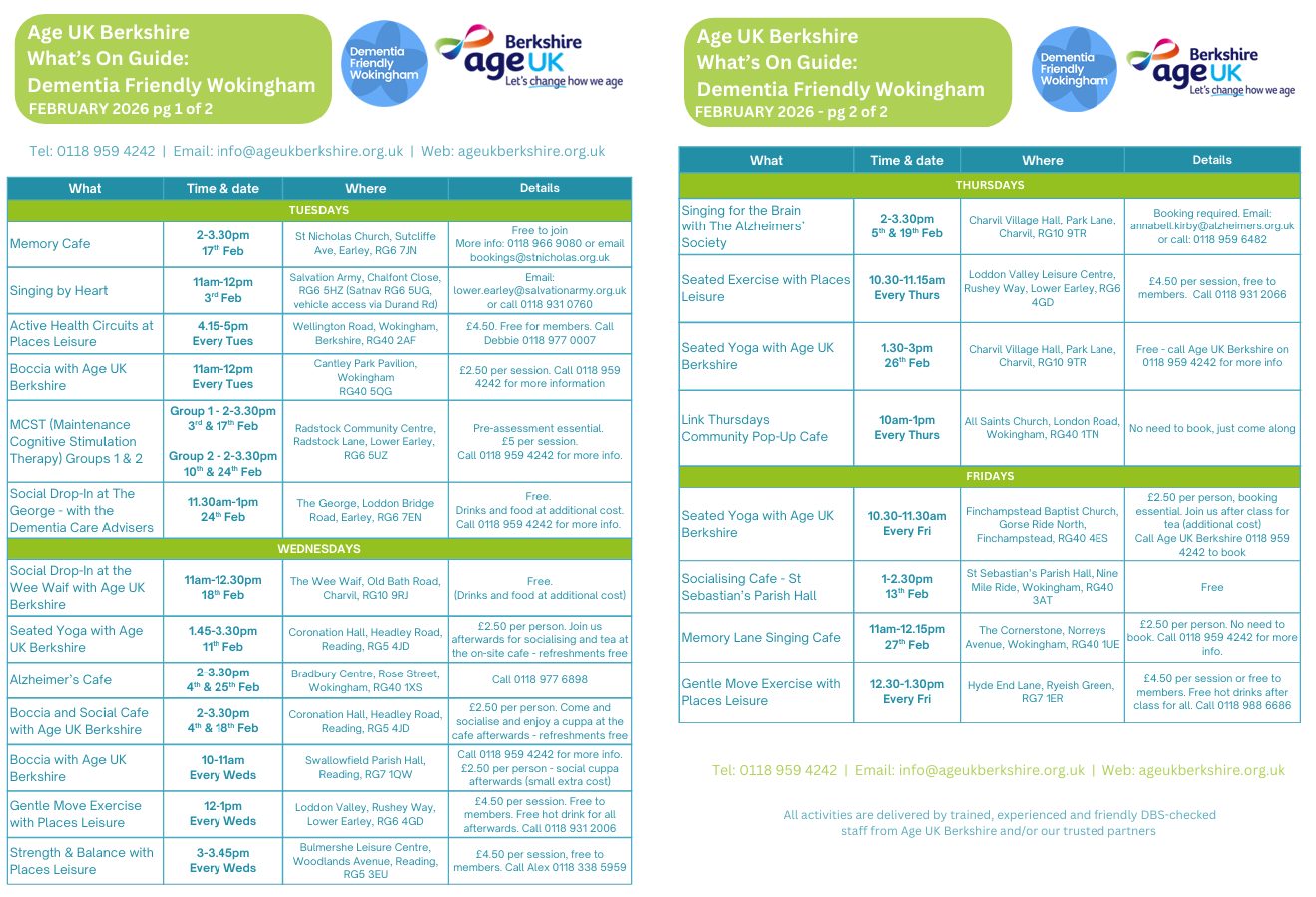
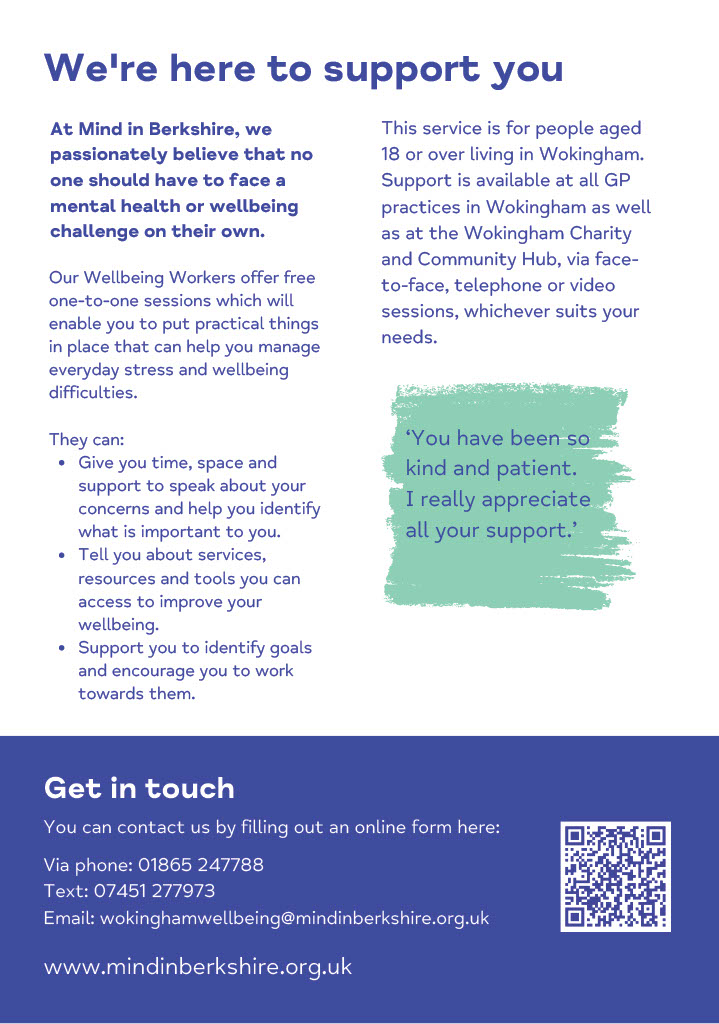
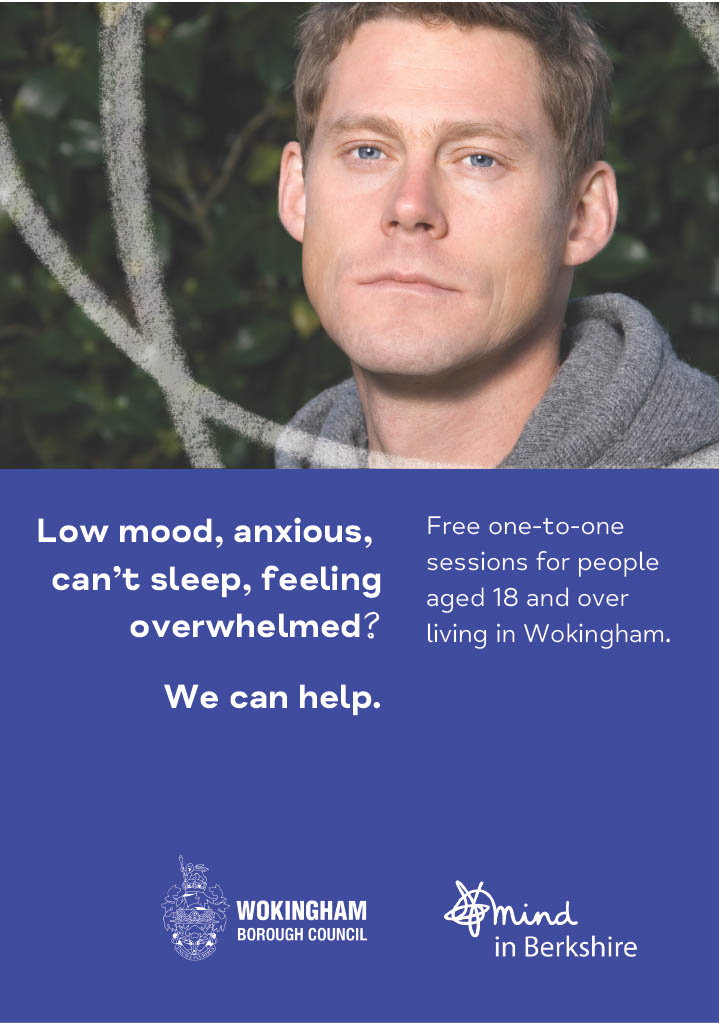
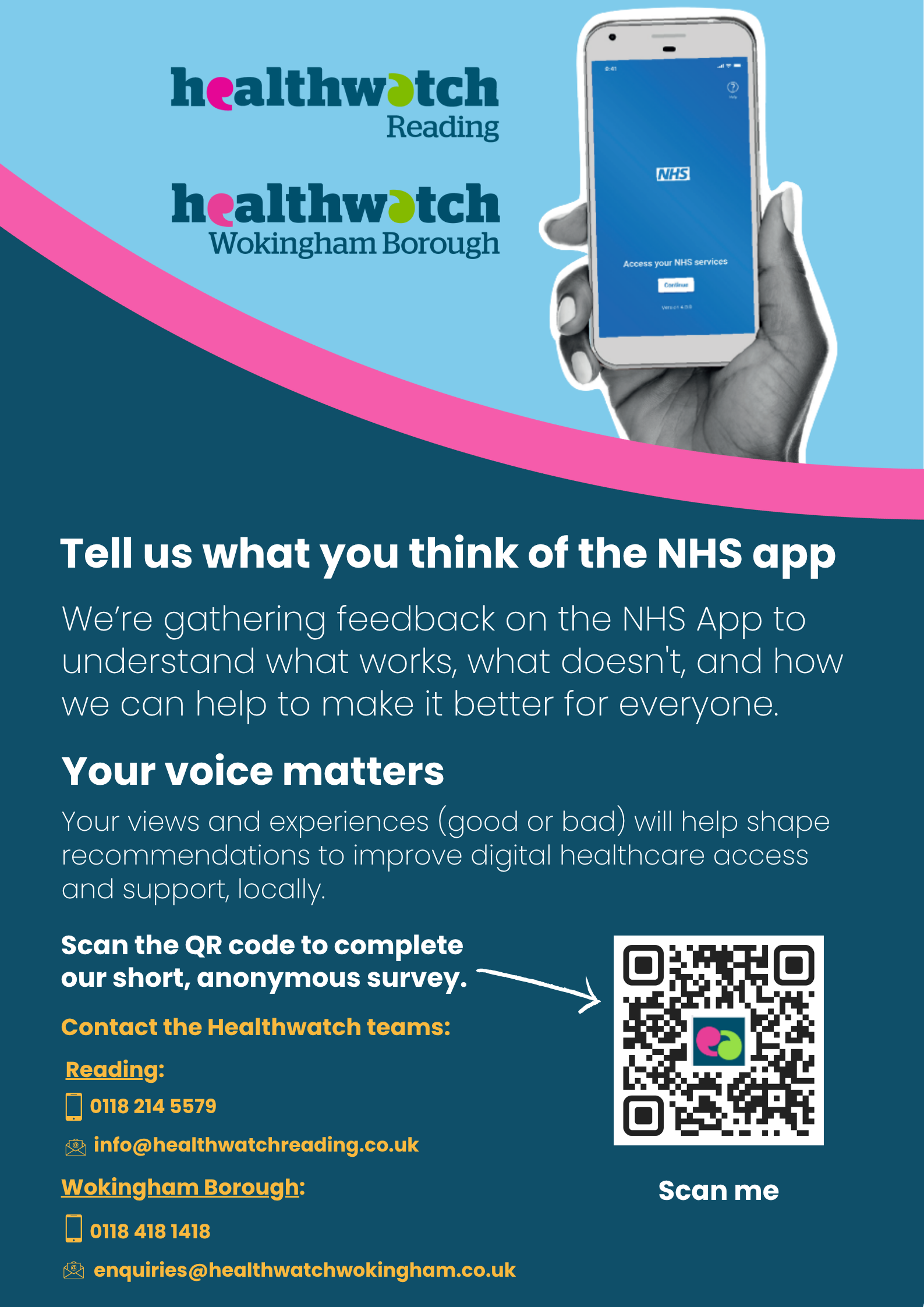
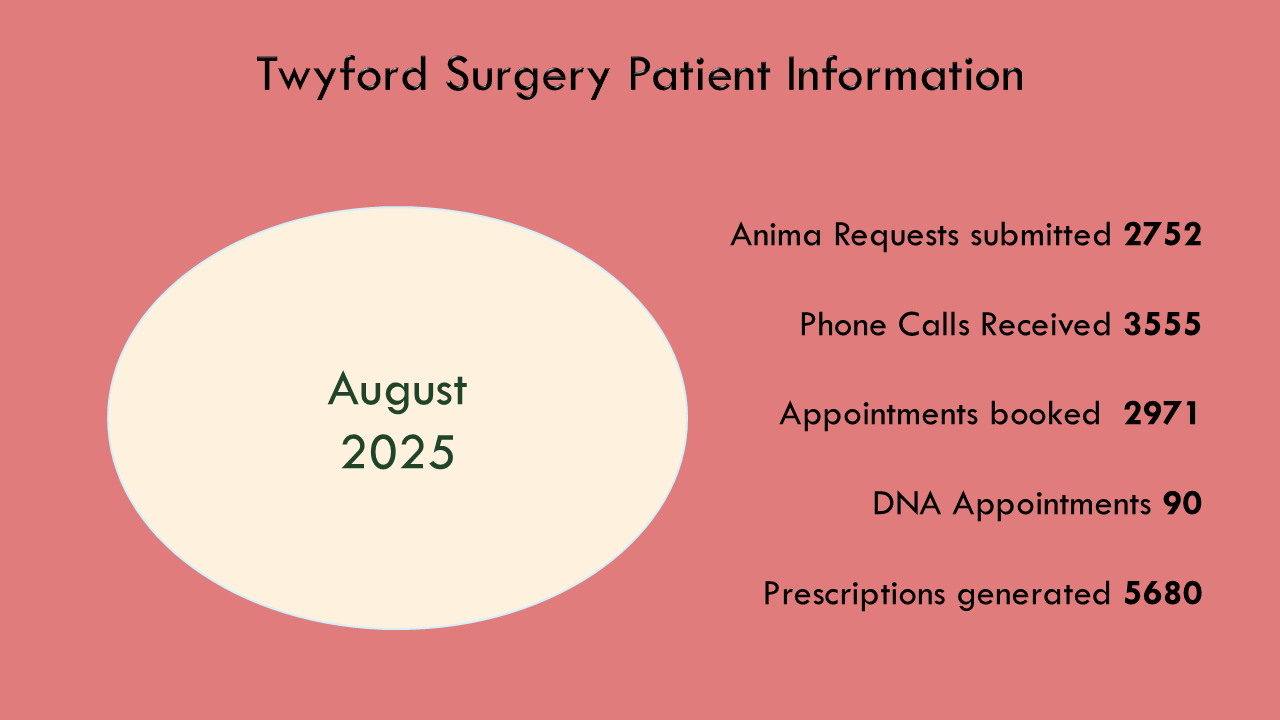
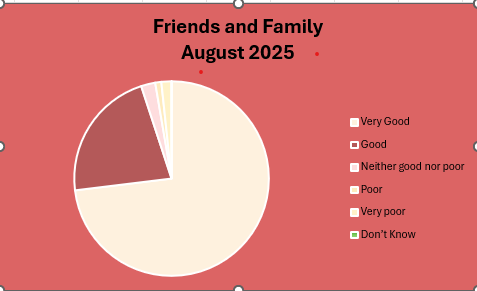
Did you know that Age UK Berkshire host and organise dementia friendly activities throughout Wokingham Borough.
See the pictures for more information on what is happening in February.
Did you know that Age UK Berkshire host and organise dementia friendly activities throughout Wokingham Borough.
See the pictures for more information on what is happening in February.
Twyford Surgery is an approved/accredited learning environment.
Throughout the year we may host undergraduate students such as those completing degrees in Paramedic Sciences or Physician Associate students from the University of Reading.
We may also host Medical Students from London or Oxford from time to time.
These learners are ‘preregistration’ and will therefore either be solely observing clinicians work in practice or may on occasion be consulting patient under the direct supervision of a senior clinician.
Twyford Surgery is also now a training practice, and this means we will be helping to train the GPs of the future.
These are fully qualified doctors who have been working for a minimum of 2 years already in hospital positions. A final year GP trainee will have a minimum of 4 years postgraduate experience already.
The following is some important information on the background to trainee GPs, sometimes also referred to as Registrars, and some special circumstances that relate to their training and requirements to become full qualified independently practicing GPs.
Pathway through the training system
To become fully qualified independent GPs, doctors need to go through the following:
- Medical School – this is normally 5 years. You are not a doctor until you have graduated from medical school
- Foundation years. Called FY1 and FY2 (Foundation Year 1 and 2). These are two years in which newly qualified doctors rotate around posts. These are normally hospital posts, in which they may work four months in each of several specialities. They may have a GP placement as part of these years. They are qualified doctors at this stage and are paid a salary. They must demonstrate various competencies to progress.
- Specialty training. Once the foundation years are completed, doctors can choose to train to become a GP. They can do this in three years – called ST1, 2 and 3 (speciality training years 1-3). The first two of these years comprise a combination of posts in hospital departments and in GP surgeries. For the final year, they are attached for the whole year to a GP practice, as an ST3 trainee.
Exams
To progress to be a qualified GP, trainees must pass various exams. There are 2 exams to complete to gain an MRCGP qualification (Member of the Royal College of GPs). This qualification allows GPs to work as fully qualified, independent GPs. These are the AKT (Applied Knowledge Test – which is a written exam), and the SCA (simulated consultation assessment – which is a practical exam). Trainees at the practice may therefore be preparing for these exams.
Some trainees choose to take extra qualifications, although these are not mandatory, such as diplomas in various specialities.
In addition to the above exams, they need to complete an e-portfolio online of their learning experience, reflection on this, and skills gained, etc.
Special circumstances in consultations
JOINT CLINICS
Trainees will spend time sitting in on other clinics to observe other’s consulting skills or learn more about specialist clinics. They will also sometimes be running “joint” surgeries with their trainer – i.e. where both Dr Hey and the trainee are seeing patients together. This allows direct observation of either the trainee consulting, or the trainee observing the consultation methods of their trainer and joint reflection and learning on cases.
VIDEO RECORDED CLINICS
The other special situation for trainees is that they will need to record some of their consultations, and patients will be notified on days that this is happening. They will be notified electronically when the appointment is booked and there will be a consent form to complete.
Only the trainer and trainee will watch these videos and they are for the sole purpose of assessing and reviewing consultation skills of the trainee. These recorded consultations without the trainer present (as with joint clinics as above) provide an invaluable different perspective on consulting skills to be reviewed and can really help highlight specific points (good and bad) for the trainee to observe themselves doing and be able to reflect upon.
Videos are deleted in a timely manner and held as confidentially as any medical records are.
There is no obligation for patients to agree to this, and you have the right to decline if you prefer to do so.
We thank you all for your patience and input with helping us to train the GPs and healthcare professionals of the future. We wouldn’t be able to do it without your support.
We are pleased to announce we are now able to offer a limited service for Mounjaro for weight loss. During this phase of the government roll-out of this plan, the eligibility criteria will be very restrictive and the majority of patients with obesity consequentially will not be eligible to receive this at the present time.
We will be actively identifying patients who meet the criteria and sending invitations to discuss the option of starting Mounjaro injections therefore there no need to contact us. In essence this is currently patients with a BMI of 40 or more (with a slight adjustment for people of higher risk ethnicity) who also have 4 of 5 co-existing conditions.
For further information on the criteria, please see the following link:
https://www.england.nhs.uk/ourwork/prevention/obesity/medicines-for-obesity/weight-management-injections/
We are pleased to announce that Twyford Surgery has now been approved as an accredited learning environment by the Thames Valley & Wessex Primary Care School.
There has been a lot of work in the background preparing and ensuring processes are in place to make certain that we provide an effective and safe placement for learners of different backgrounds.
A number of patients have already been aware that we have had final year physician associate students undertaking their GP placement with us recently, and we are grateful to those patients who have and continue to facilitate the learning of our students.
We are likely to host learners such as medical, physician associate and paramedic students in the future.
We will also welcome back GP trainees starting this summer. Many of you will remember Dr Davies previously trained GPs including those that went on to stay at Twyford for many years, such as Dr Grantham and Dr Ruffle!
Dr Hey has now been approved as a GP trainer and will supervise our first final year trainee commencing for 12months in August.
Dr Agarwal is also hoping to finalise his approval in the coming months, having previously trained GPs in London before he joined us at Twyford.
We are really excited by this practice development. Providing opportunities for learners of all types to spend time in General Practice is of paramount importance. Enabling an effective placement will educate and highlight the very varied work that is done and the challenges we face in relation to the primary and secondary care interface so that those who go on to work in secondary care understand what we do better. But most of all, we want to provide a rewarding placement that shows what a fantastic place to work general practice is, and encourages more into primary care to bolster our future workforce. We would love to train the future Dr Granthams and Ruffles who spend their careers at Twyford!
We thank you all for helping us to train these future healthcare professionals. We couldn’t do it without your support.
Please be assured that all students are fully supervised, and no assessments will be undertaken by them without a complete review of the patient by a supervising clinician. More information will be updated and made available on our website regarding learners. And of course, if you ever feel you would rather not see a learner when this is stated, it is your right to say so, and they will then either step out of the room when observing a clinician, or you will not be asked to see them before the GP review.
GP trainees are fully qualified doctors who have spent at least 3 years working in hospital jobs. They will see patients directly but will be fully supported, and all their patients will be discussed with their mentor on the same day. When a trainee has concerns or queries immediately, a senior GP will be available to offer support there and then. Again, further information regarding the process of GP training will be made available on our website.
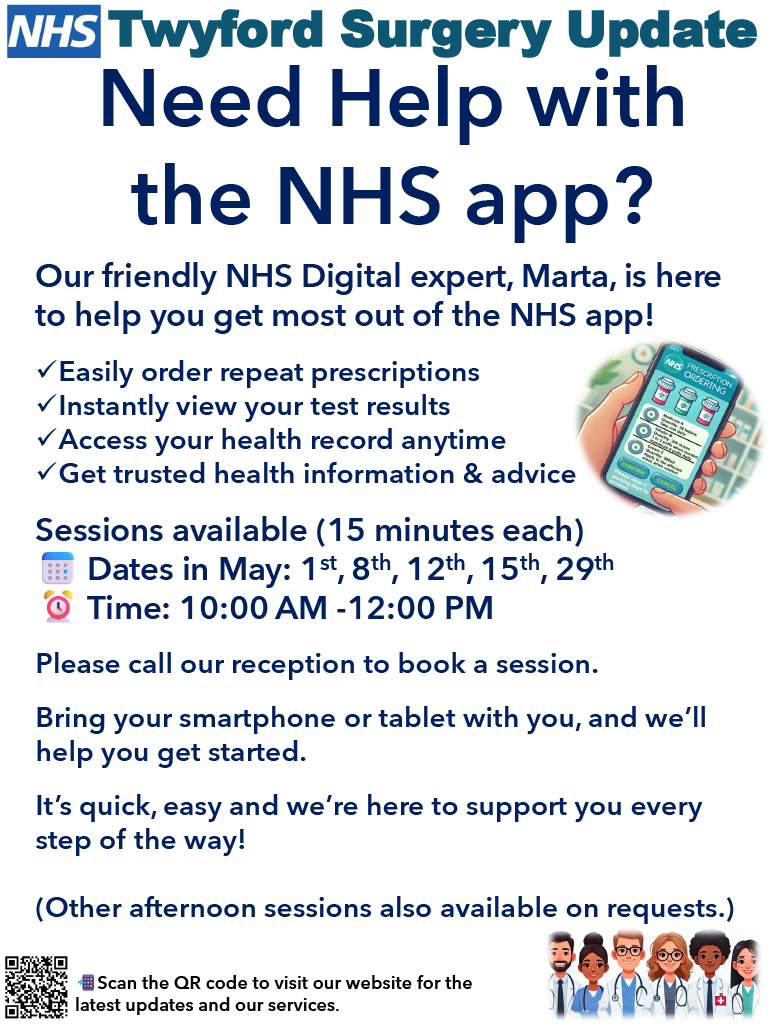
Need advice with the NHS App? Help is at hand!
Need advice with the NHS App? Help is at hand!
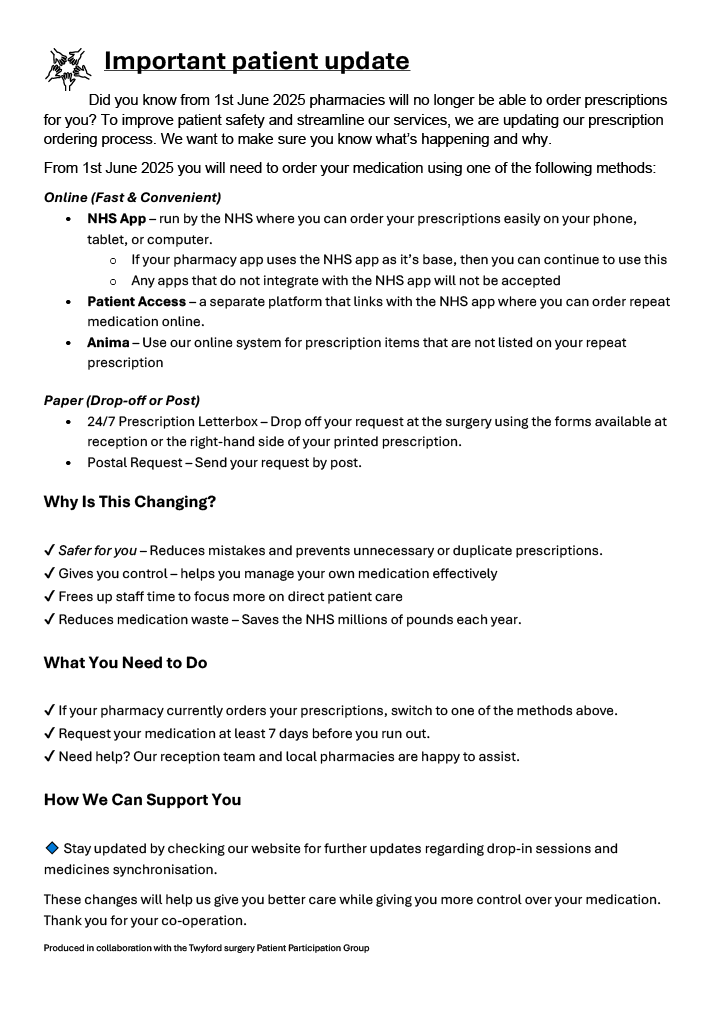
Did you know from 1st June 2025 pharmacies will no longer be able to order prescriptions for you? To improve patient safety and streamline our services, we are updating our prescription ordering process. We want to make sure you know what’s happening and why ...
Did you know from 1st June 2025 pharmacies will no longer be able to order prescriptions for you? To improve patient safety and streamline our services, we are updating our prescription ordering process. We want to make sure you know what’s happening and why ...
This has now been resolved Our telephone system is experiencing technical issues. It has been confirmed that this is a national issue. Anima is working as normal. Please bear with us whilst the telephone engineers try to resolve this.
This has now been resolved Our telephone system is experiencing technical issues. It has been confirmed that this is a national issue. Anima is working as normal. Please bear with us whilst the telephone engineers try to resolve this.
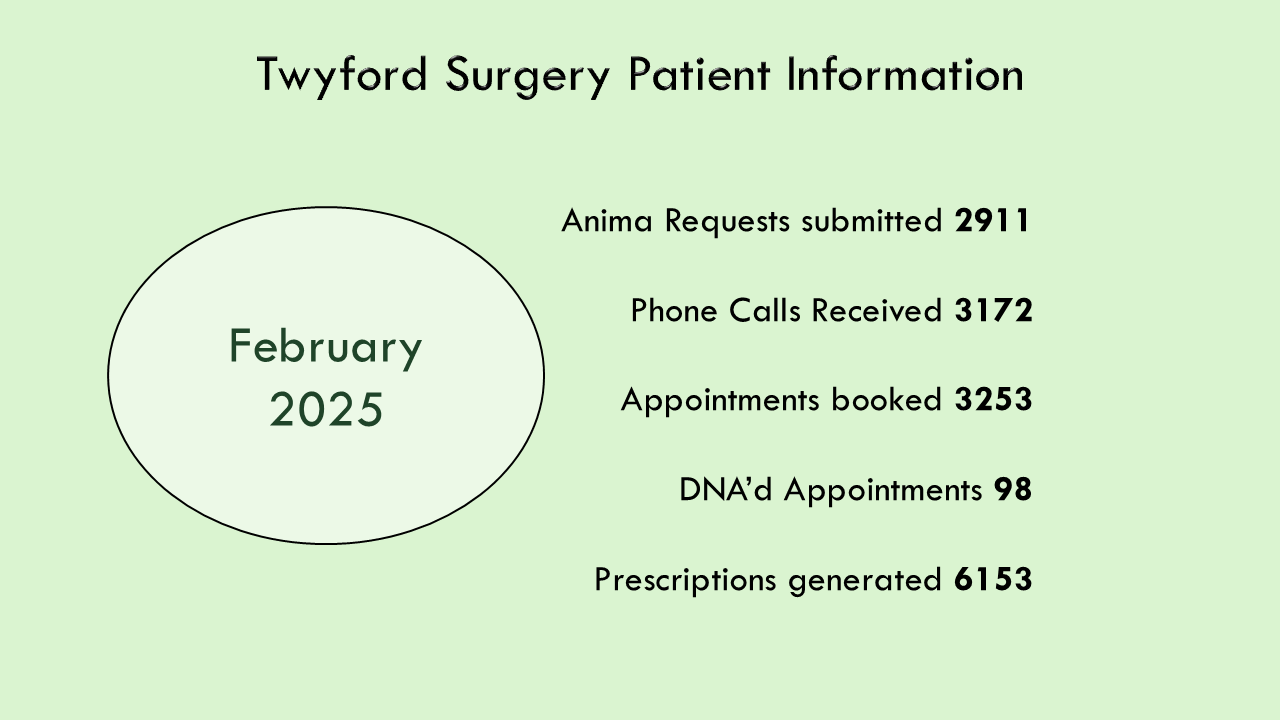
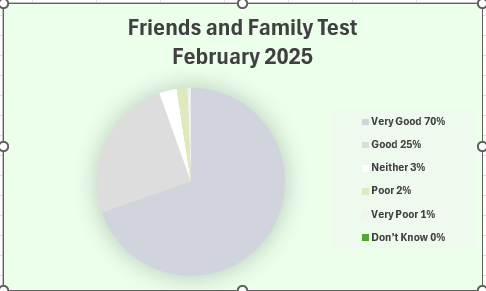
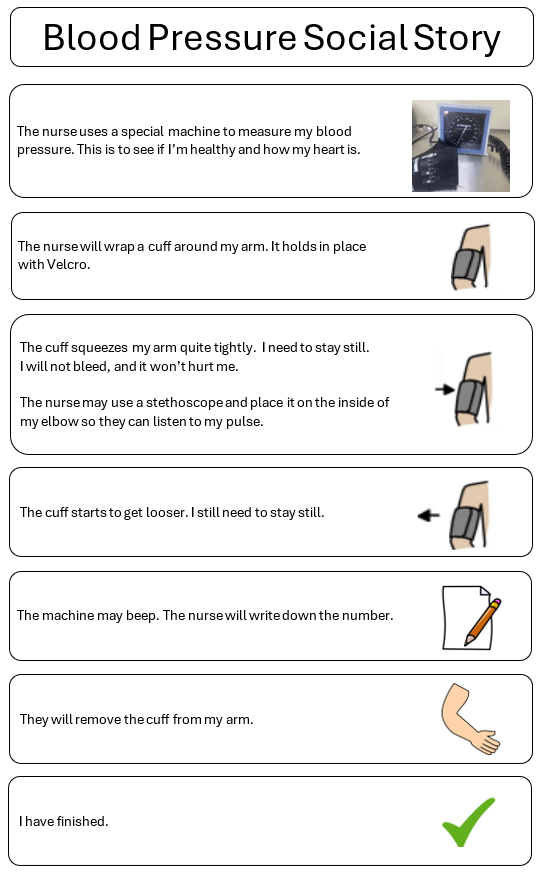
A social story is a simple story that describes social situation. It is especially beneficial for those with learning disabilities but can help all children or those with limited understanding. The simple language and pictures can help reduce anxiety. This is because it can help them to understand what to expect when visiting the doctors making the experience feel less intimating and more predictable.
We have created a social story that explains what will happen when they have their blood pressure checked.
Please also see the blood test social story.
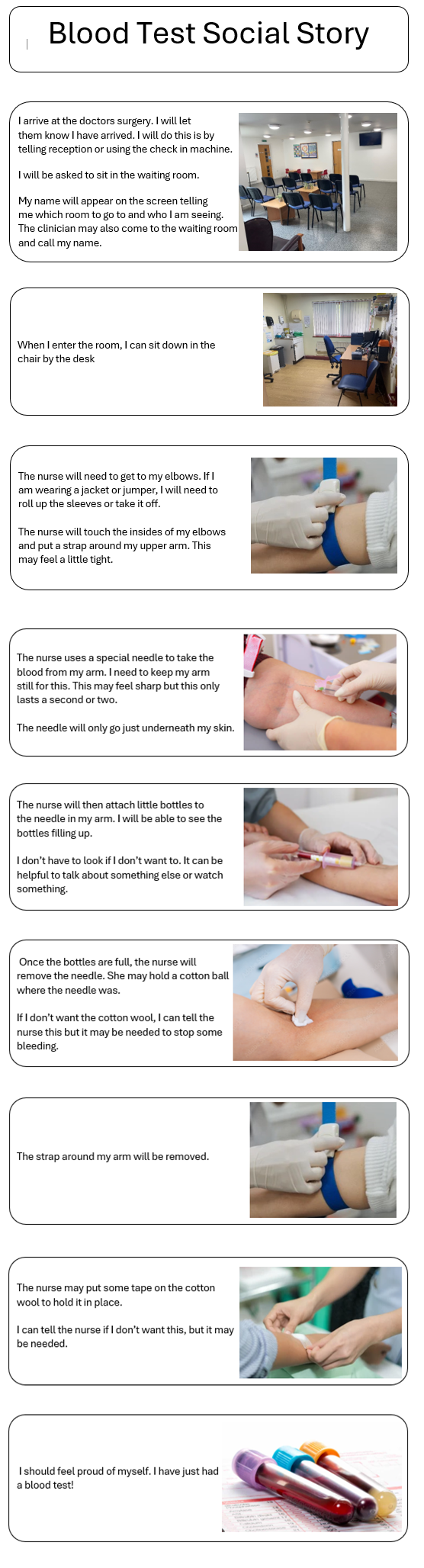
A social story is a simple story that describes social situation. It is especially beneficial for those with learning disabilities but can help all children or those with limited understanding. The simple language and pictures can help reduce anxiety. This is because it can help them to understand what to expect when visiting the doctors making the experience feel less intimating and more predictable.
We have created a social story that explains what will happen during a blood test to help alleviate any anxiety there maybe surrounding this.
Please also see the blood pressure social story.
How to request a telephone appointment with a clinician
To book a phone appointment, fill out an Anima request form to tell us what you want to talk about. If you are unable to do this yourself our reception team will be glad to assist you and complete the form on your behalf.
What happens once a request has been submitted?
A senior clinician will look at all requests and decide who is best to speak with you and how soon the appointment should be. Sometimes, even if you ask for a phone call, the clinician may decide that an in-person appointment is better. You may be given an appointment on the same day, within a week, or within two weeks. During the winter season the wait for routine appointments may be longer than two weeks.
How will I be contacted after I have submitted a request?
If your telephone request is marked as urgent, a clinician will contact you by phone on the same day. For routine appointments, we will send you a link to choose a convenient time over the next few weeks. If you don’t have an email address, our reception team will contact you to assist you in scheduling your appointment.
Will I be contacted at the exact time of the phone call?
To ensure everything runs smoothly, we recommend being available for the whole morning or afternoon around your appointment time. If you have a specific meeting/time that day where you will be unavailable please let reception know and they will add a note on your booking.
Why is this?
Our clinicians will do their best to call you as close to the scheduled time as possible. However, due to their in-person appointments, emergencies, and other responsibilities, exact times can sometimes shift. We appreciate your understanding and flexibility.
Do I need internet access?
If you do not have internet access, our reception team can help you book the appointment through Anima.
What is the advantage of Anima?
Using Anima is a faster way to seek the help and advice you need at the right time, the right place and with the right person. Please bear this in mind and keep the phone lines free for those who cannot use the internet.
Will I only be contacted if an Anima request has been submitted?
Occasionally one of our clinicians may initiate unsolicited contact directly with patients for example to discuss a recent abnormal blood test result. This will primarily be through your email account, by telephone or an invitation to book a review appointment at your convenience.
What do I need to do on the day of the appointment?
On the day of your phone appointment, please make sure your phone is charged and turned on from 8am for a morning call and from 1pm for an afternoon call. The clinician will call the number you gave us – usually your mobile number.
What if I have been given an on the day appointment?
If you have been given an appointment on the day you may get a call anytime in the morning (8am-1pm) or afternoon (1pm-6:30pm). If you have used the link to book a set time the clinician will attempt to call as close to the original slot as possible within a 2-hour window.
What if I miss the call?
If you miss the first call, we will try to call you again right away. If there are other numbers on your record, we might try calling those too.
The clinician will call you with a ‘No caller ID’ or sometimes through the practice phone line. Calls generally start from 800am till 630pm.
We know it’s easy to miss a call, even if you’re expecting it. After failing to reach you we will then leave a voice or text message informing you we have tried at that time and advising you we will call back one last time within the clinic session.
What if I miss the call again?
Should you be unavailable on the last attempt you will then receive the following voice or text message and will need to submit a new Anima request.
‘Unfortunately, despite at least 3 attempts we have not been able to contact you today. If you still need to speak to a clinician, please contact us via anima. Unless urgent this will be booked on another day. In the event of a medical emergency call 999’
All call attempts are recorded in your notes. If the clinician feels your issue is urgent and cannot wait, they will ask reception to try to contact you to rebook.
We follow this policy to make sure every patient is treated fairly. The only time we might make exceptions is if the clinician is very worried about your health.
What if my slot has passed and I have not received a call or text messages notifying of attempts to call?
Sometimes clinicians run late because they are handling emergency cases or supervising others. If you have a morning appointment and haven’t been called by 1 PM, or an afternoon appointment and haven’t been called by 6 PM, you can call reception to see if you can make a later time or book another appointment.
What if I don’t hear the one ring and I get the message of repeated attempt made?
A clinician will always call and document this in the notes. The receipt of the text messages shows our number for you is correct – our computer system links your contact details with our phone system to remove human error in dialling incorrect numbers. Common reasons for missed calls include temporary lack of signal where the phone doesn’t ring. Additionally, unless a voicemail is left your phone may not record the missed call. Another possibility is you may have your phone settings blocking calls from unknown callers. Please ensure this feature is switched off when you are expecting your telephone consultation.
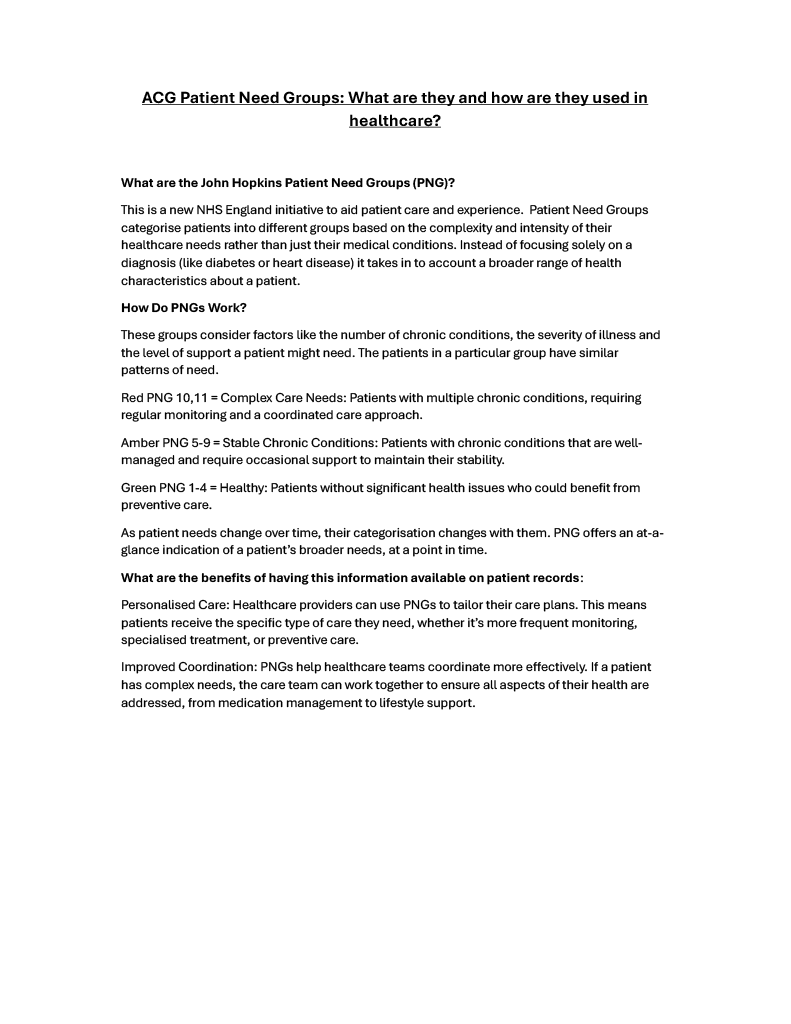

Flu and RSV vaccinations are still available for our eligible patients. Please submit an Anima request or contact reception to book.There has been an increase in respiratory illnesses, and we encourage our patients to protect themselves. To check your eligibility please follow these links
https://ukhsa.blog.gov.uk/2024/09/23/your-guide-to-whos-eligible-for-the-2024-flu-vaccine/
https://www.gov.uk/government/publications/respiratory-syncytial-virus-rsv-vaccination-for-older-adults/your-guide-to-the-rsv-vaccine-for-older-adults#:~:text=Everyone%20turning%2075%20years%20old,day%20before%20you%20turn%2080.
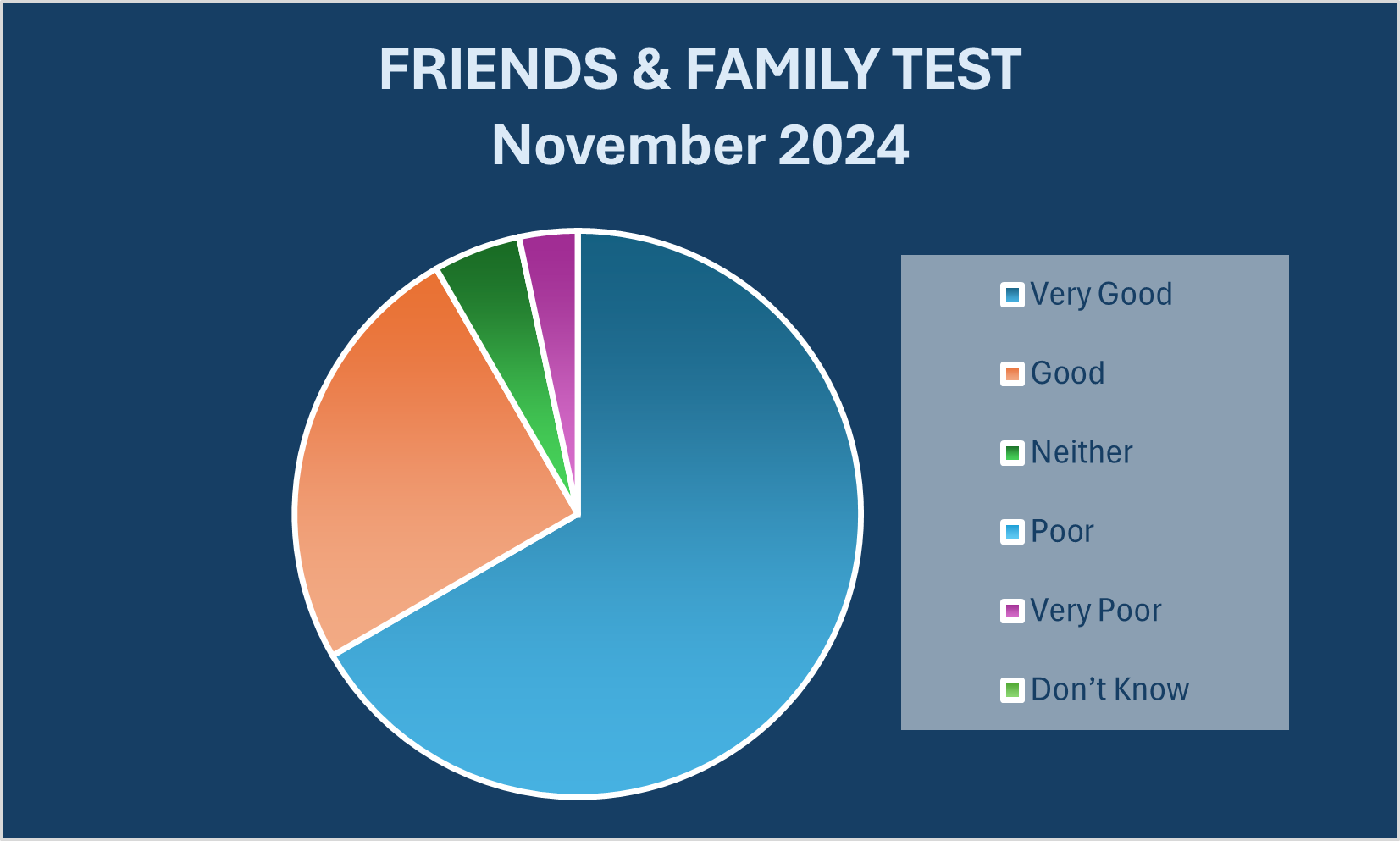
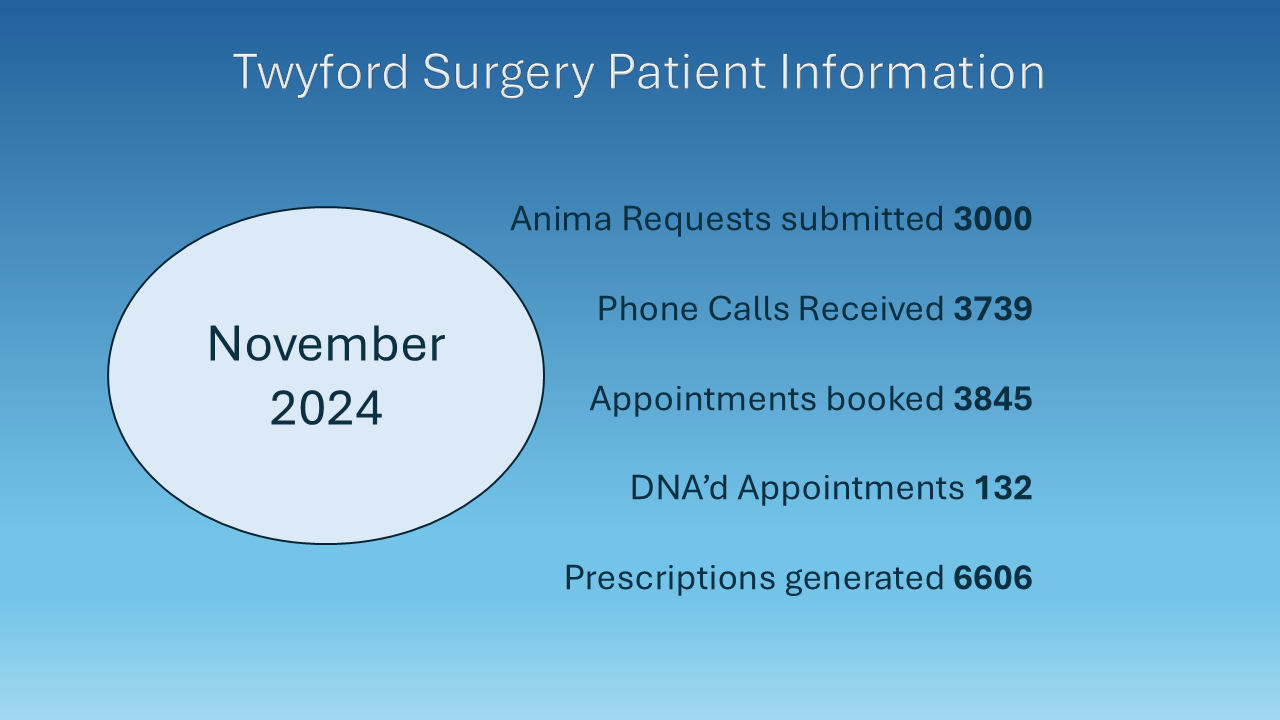
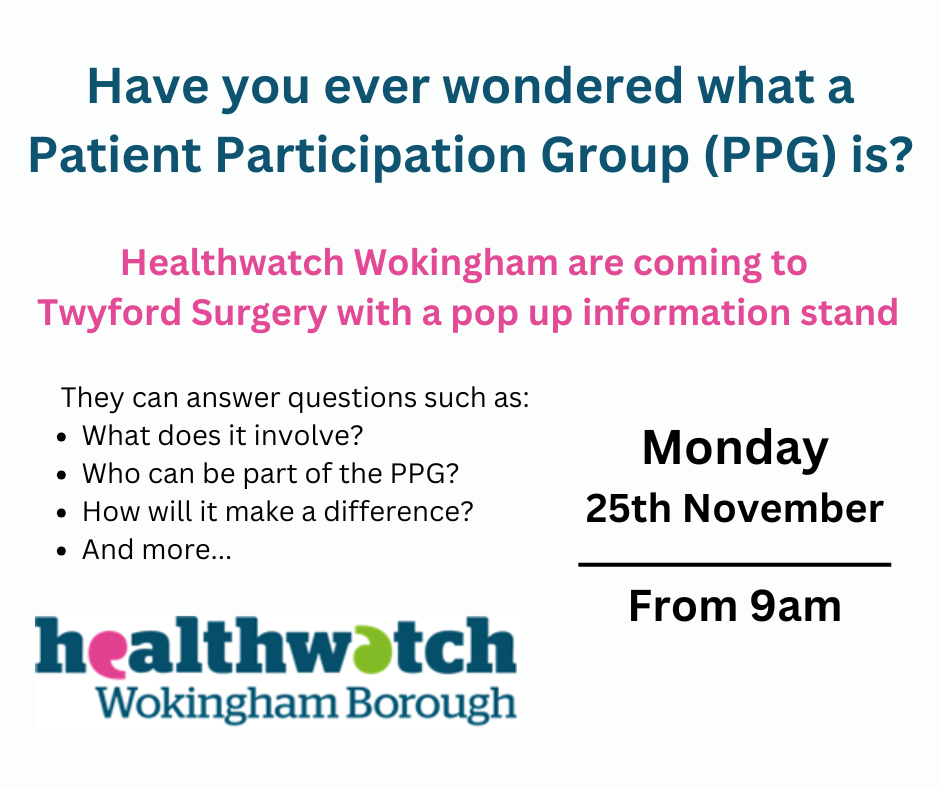
Healthwatch Wokingham are coming to Twyford Surgery on Monday to share information about what a patient participation group is and how to get involved.
Healthwatch Wokingham are coming to Twyford Surgery on Monday to share information about what a patient participation group is and how to get involved.

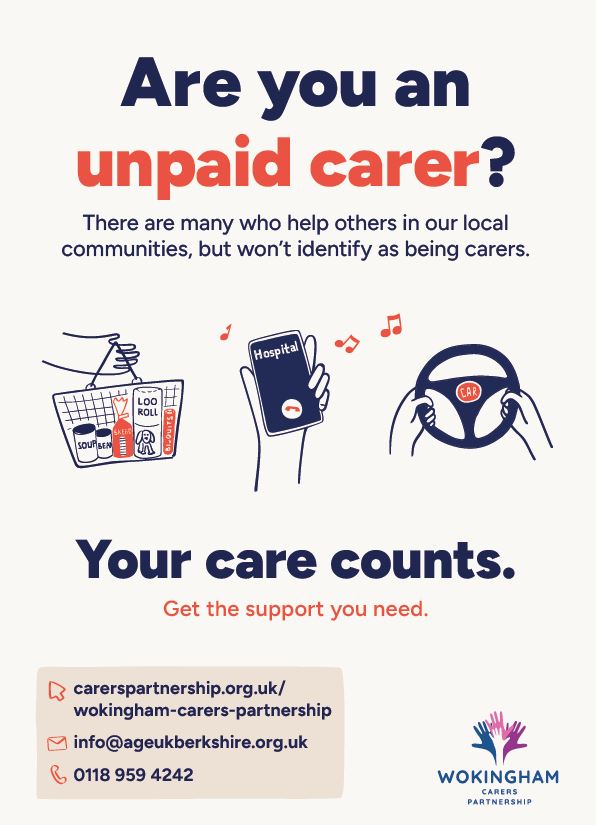
We're very excited to announce that the Wokingham Carers Partnership will be manning an information pop up stand at the surgery on Tuesday 19th November between 9am-11am.
Their aim is to spread awareness and to make sure carers are aware of their service and getting the support they need.
So come along to the surgery to see what it's all about!
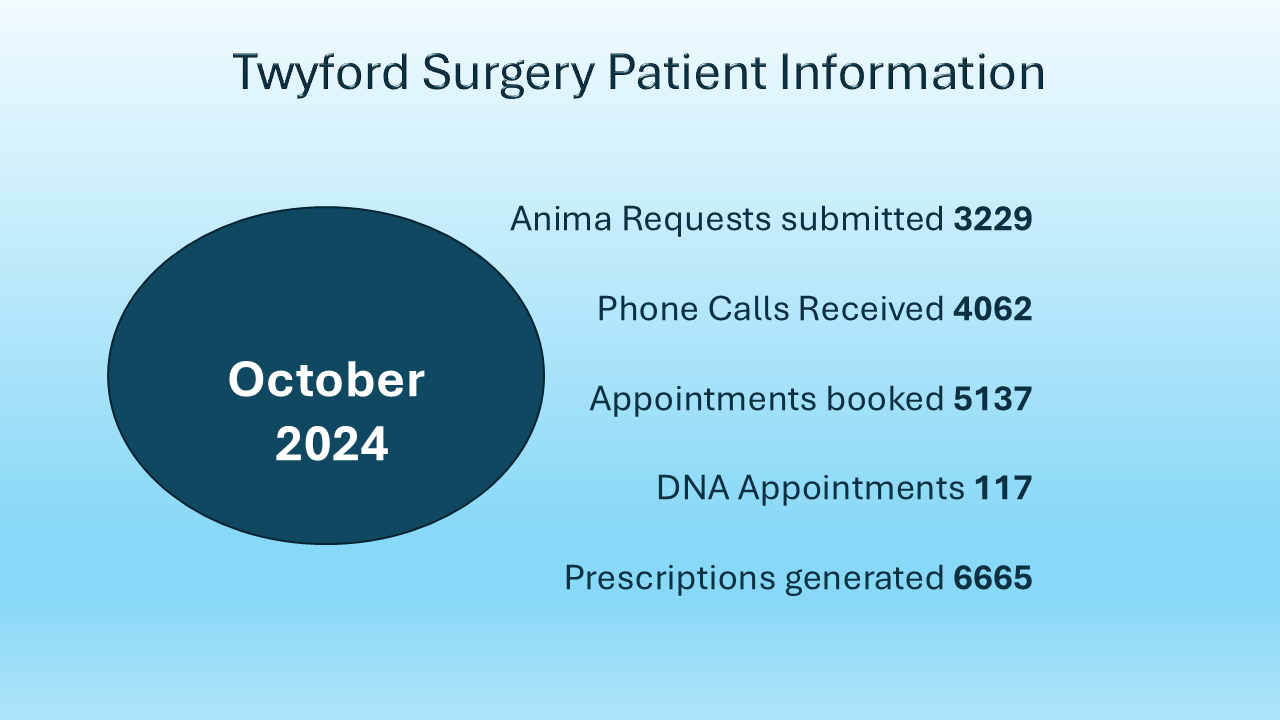
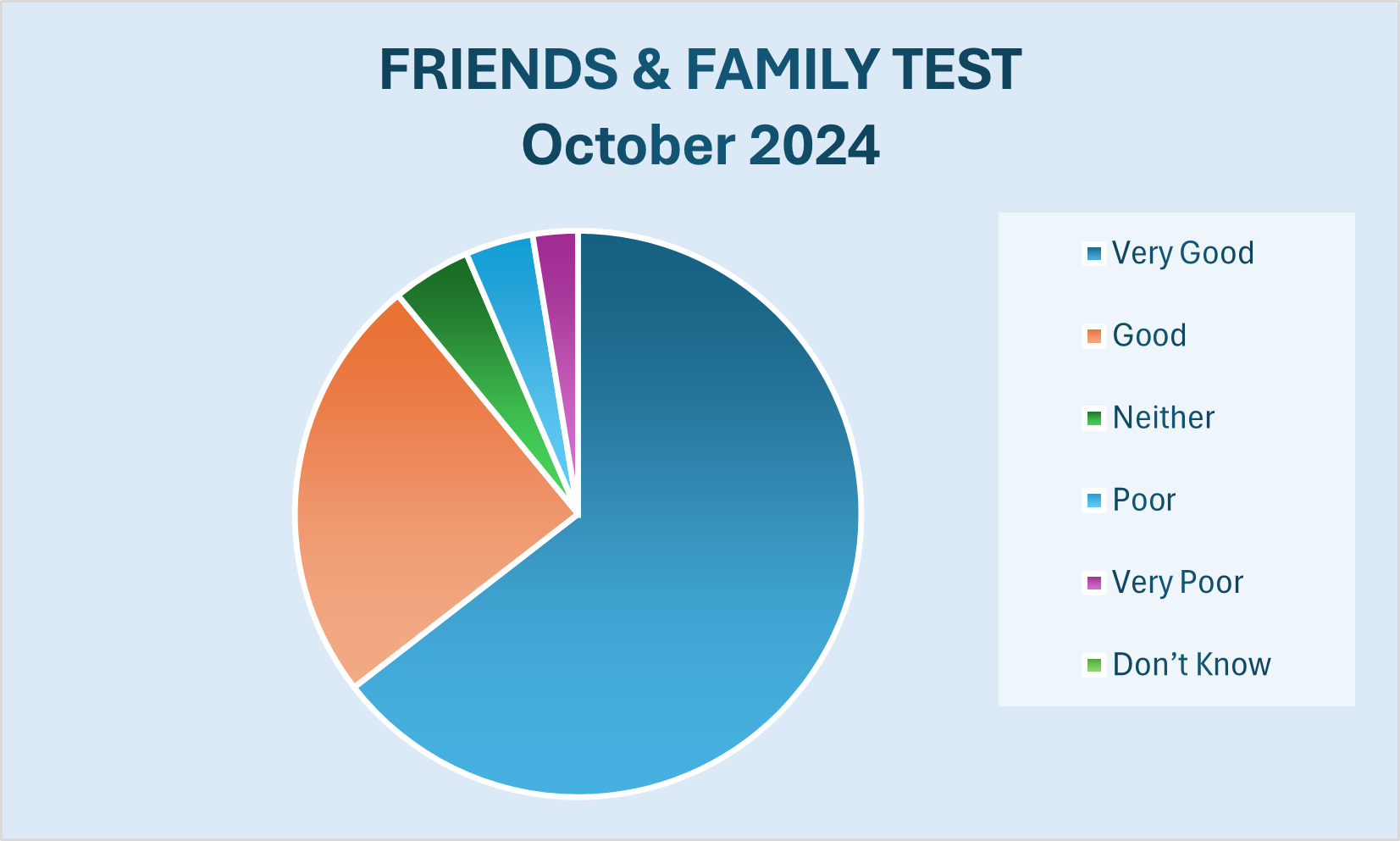
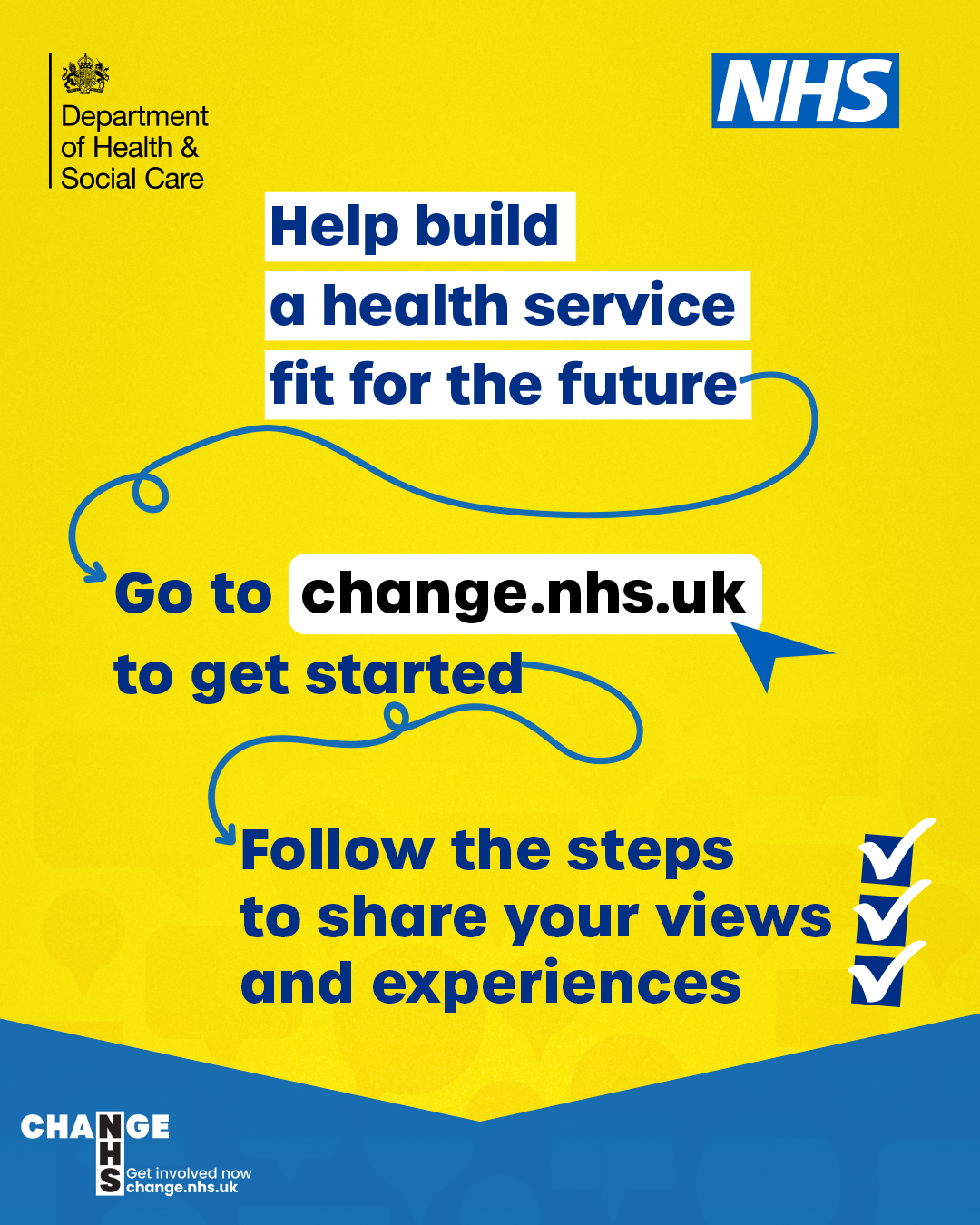
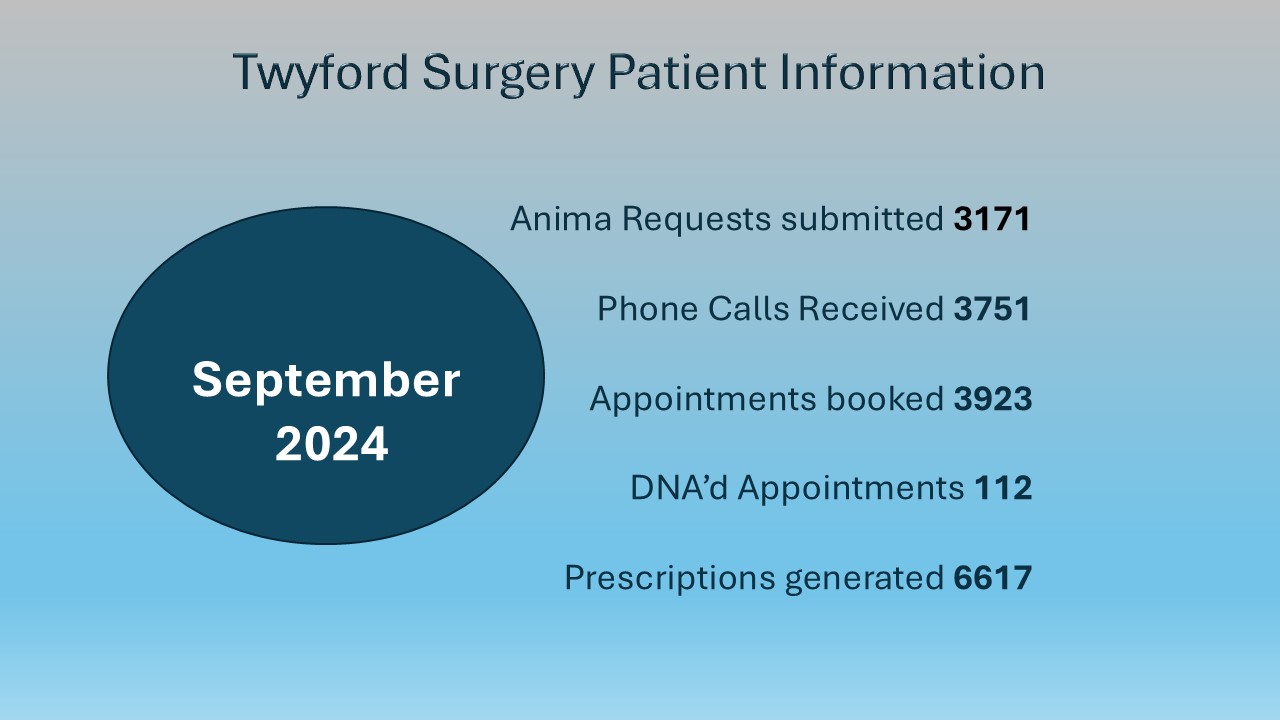
We need your voice to help build a health service that's fit for the future.
It’s quick and easy to get involved, and it’ll be worth it.
Whether you have a little to say or a lot, your views, experiences and ideas will shape immediate steps and long-term changes: a new 10-Year Health Plan for the NHS.
Click on the link below to find out how you can take part.
In February we introduced a new digital triage system to meet requirements from NHS England. We wanted to summarise again why and how we chose this system in meeting NHS England and NHS contract requirements to move to digital ways of working.
With increasing demand on our services and reduced GP numbers, we like most practices have a more diversified clinician mix. This means you may not always see a GP for your concern or review, and digital triage allows us to streamline getting you to the right person, or even offering direct advice. It also means that a senior GP is triaging all the daily requests and assigning them to an appropriate staff member to action in an appropriate timeframe. This is clinically fairer for all patients and is a step away from the old 8am rush on the telephone. We know nationally, as well as locally, that the 8am rush was not the best system and will lead to very much a first come first serve service. It also means that our phone lines are now much clearer and in general, if you need to phone you get through much quicker!
What is more, by gaining experience with the changes over the last 6 months, and increasing confidence, we have now reached a point where we do not limit requests each day. What this means versus the old system is that you will have an ‘online’ consultation, be offered advice, an appointment, or redirected no matter what your query. And this is possible because we have a senior clinician triaging and reviewing all requests so they really are streamlined as best they can be. Previously once the appointments were full, you were often told to ring back tomorrow which we know was far less than perfect. Our wait times for a routine GP appointment are also now less than 4 weeks.
By using the system you are therefore helping with triage, and while no system is perfect, this was the best option we felt to be on offer. If someone is unable to manage online they are able to phone in, and the details are taken by reception staff for the patient. If there is routine screening due or you’ve received an invite to book an annual review then please call, you can be booked in directly.
If anyone has specific queries or comments or feedback on the system, please raise them with the surgery, Feedback - Twyford Surgery (twyfordsurgeryberkshire.co.uk) we will gladly look at if it is something we can help directly with clarifying or incorporate feedback in how we utilise the system itself as we review and go along. We now have shorter wait times for appointments and have had many positive comments and feedback. We are also looking at introducing a help desk in reception where we can work through difficulties with the system and the NHS app.
We are working hard to put together clear clinical and administrative pathways and protocols to ensure consistency across how we manage requests or patient needs. This may mean that you will find some things we used to do in one way is no longer the case. This may be frustrating at first, but a significant amount of thought will have gone in to making these decisions, which are designed to make our service fair and honest to all, and to ensure best use of resources.
There has been a lot of discussion at the surgery around recent proposed industrial action by GPs and we want to take this opportunity to explain that most of those options put forward by the BMA were felt to be unworkable in practice and we have chosen not to implement these.
We do not want barriers to put up between us and our patients and are working hard to serve you. We do, however, want meaningful change to the way funding is allocated and how we are restrained by bureaucracy, to allow us to increase the care service you receive, so again we would suggest that if you want this too, please contact our new local MP Mr Clive Jones.
We wanted to write in support of the local community pharmacies who have recently held a lights out event. We feel their position reflects that across the board in primary care, with funding ever more directed towards secondary/hospital care. We work closely with local chemists and have engaged with them including supporting the training of their staff.
If you feel strongly about their position, please do write to our new MP Mr Clive Jones to highlight this concern and help direct them towards a meaningful debate in parliament about NHS funding particularly considering proposed reform.
Unfortunately, this funding issue relates to all primary care – and that includes general practice. We are working under intense pressure with limited resources to meet increasing demand. Unlike secondary care, we have not had significant increases in funding for many years despite increasing running costs and while having to deal with increasingly more complex health issues. Unlike secondary care we have not seen doctor numbers increase, in fact, GP numbers continue to decline. Successive governments have talked about more care within the community but without funding to back this up. Just like community pharmacies, we will see increasing closures of general practice surgeries unless this stance dramatically changes. There is a clear juxtaposition between the notion of increasing care in the community but power being held within hospital and secondary care management systems which take the vast proportion of NHS funding.
So again, we would urge you to lobby our local MP on our behalf too. We intend to invite our local MP into the surgery to gain greater understanding of our pressures and the ways in which we are trying to manage this too, seeing that this is an opportunity for real change, and clearly noting the wish to move more care to neighbourhoods and primary care. This will need better funding and more joined up governance between these separate entities in communities than currently exists if this is to work.
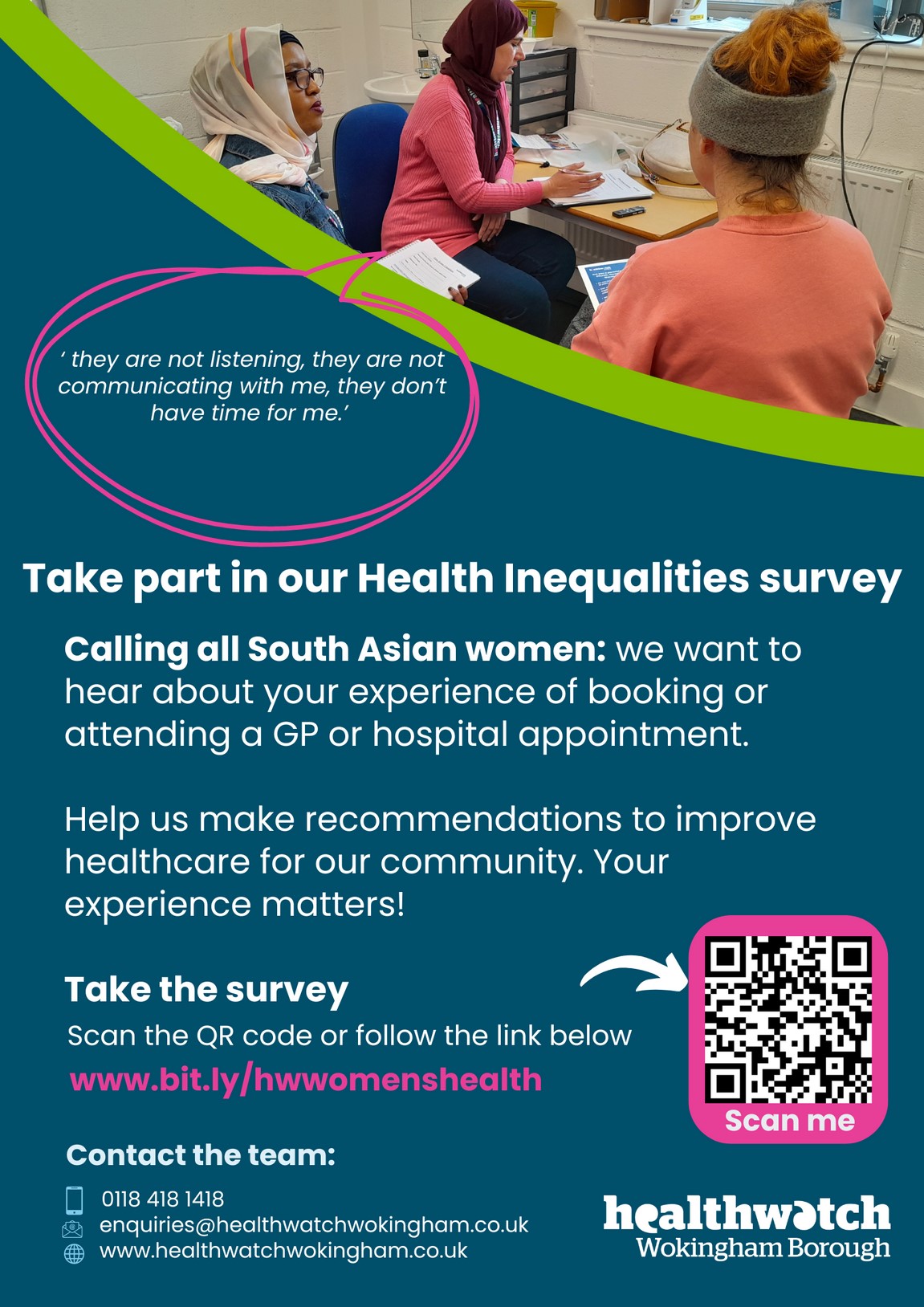
Healthwatch for Wokingham Borough are trying to understand and address ethnic health inequalities and accessibility issues in Wokingham with a focus on South Asian Women.
They want to hear about your experience of booking or attending a GP or hospital appointment. You can help them make recommendations to improve healthcare for our community.
Visit the following link to complete the survey about your experiences
or more information about the South Asian Women Women’s Health Project click on the link below:
Welcome to Twyford Surgery's new website, we hope you will find it informative, useful and we welcome your feedback about it. We will try to keep it up to date as possible with surgery changes such as new patient services available to you, COVID changes, vaccine news and latest news.
Welcome to Twyford Surgery's new website, we hope you will find it informative, useful and we welcome your feedback about it. We will try to keep it up to date as possible with surgery changes such as new patient services available to you, COVID changes, vaccine news and latest news.
Thank you for your support over the last month and patience as we all settle into the new system.
Generally, we feel positive about the changes and have had some encouraging feedback.
A few issues have arisen, and we’d like to take this opportunity to highlight a few and how we’ve changed the processes in response, as well as the help we need from you.
- We have updated the message you receive back when you submit a request as this was saying you will receive a response in 2-3 days. This meant we had some phoning up concerned about response times. To confirm, you will receive a response within the day so please do keep checking your anima account.
- If you submit a request, there is no need to call the surgery as a back-up. Currently this is clogging up our phone lines and means wait times on the phones are much longer, and this is impacting on those patients who genuinely cannot use anima. It also means there are duplicate requests entered which closes the system down when it doesn’t need to.
- Rather than everything being dealt with on the day, as this has led to a little confusion or where patients are not available when a request has been submitted and then miss appointments booked that same morning, we are going to move to sending back invite links for you to use to book your own appointments times within the available options. If your need is urgent, you will be booked in on the day, but if the issue is not urgent, you will receive a link to book an appointment either within a week, or within 2 weeks.
- While we love that you are using the system, for repeat prescriptions please use the NHS app instead, this gets your request directly to a clinician so is the most direct way of requesting.
- Please remember that there is no advantage to phoning the surgery, you will no longer be booked in directly for a GP appointment if you call (except in exceptional circumstances of urgency). You can call for routine long term health condition appointments/nursing appointments etc. but try not to first thing in the morning, and bear in mind you may wait longer on the line.
We are pleased to share that we are a member of the Dementia Friendly Wokingham Partnership. Dementia Friendly Wokingham is a group of individuals and organisations working together to improve the lives of people living with dementia, their families and their carers. It is a collaboration between Age UK Berkshire, Understanding Dementia and The Link Visiting Scheme, which is supported by Wokingham Borough Council. Check out their website for more information: Dementia Friendly Wokingham.
We are pleased to share that we are a member of the Dementia Friendly Wokingham Partnership. Dementia Friendly Wokingham is a group of individuals and organisations working together to improve the lives of people living with dementia, their families and their carers. It is a collaboration between Age UK Berkshire, Understanding Dementia and The Link Visiting Scheme, which is supported by Wokingham Borough Council. Check out their website for more information: Dementia Friendly Wokingham.
The way you make an appointment is changing from 1 February.
Background
From 1st February the surgery will be updating its access routes and streamlining the process to get a GP appointment. The Government GP recovery plan sets out requirements for surgeries to become more digital.
Many of you are aware the current situation in the NHS is very difficult. Demand on services simply outstrips supply. This has led to long waiting times and the need to prioritise based on clinical need. This is no different in Primary Care or at Twyford Surgery.
The staff in the surgery are working tirelessly to meet these demands and provide appropriate medical care. This includes everyone, from front of house reception teams to clinicians, as well as the secretarial and administrative staff working hard behind the scenes.
We know and appreciate that the 8am rush for a GP appointment is stressful at a time when you are probably worried about a health issue. With the new telephony system, we can analyse call volumes and outcomes. At 8am we have over 50 calls into the surgery within an hour, but after 9/10am this volume drops dramatically to around 10 an hour. The reality is that the majority of health complaints do not require an urgent appointment based on clinical need. Thus, the system itself can create more stress than necessary.
To address this demand-capacity balance in 2019 the Government pledged to increase “GP appointments” by 50 million a year, and that they would recruit 26,000 additional staff for this purpose. It’s important to note that by ‘GP appointments’ they mean the entire General Practice team, which incorporates a host of different healthcare professionals – not just GPs.
Multidisciplinary staff working is likely to continue. This means that there are new direct routes to see a wide range of health professionals with different skills who will be able to help with a variety of health needs. We must use their expertise wisely to enable more efficient and effective patient care, and this means that you may not always see a GP despite thinking you need to.
Furthermore, the government has asked that general practice surgeries become more digital, and this is part of their Road to Recovery Plan for General Practice.
Impact at Twyford Surgery and Planned Changes
We have reviewed all the available ways of managing this digital transformation and spent a long time analysing our own data, the available systems and how to use them and why.
We have decided to implement a new digital triage system. This will help in some way to reduce the burden at 8am, and ensure you see the right person at the right time.
For this we will use a healthcare software system called Anima. There are many surgeries in the area and beyond who are now utilising the same software.
The forms will ask for a short amount of clinical information such as:
- What the nature of the symptoms/problem is
- How long they have been present for
- What concerns or ideas you might have about it
- Type of appointment you would prefer
This will provide the duty clinician with essential information to process the request and triage it to an appropriate clinician or administrative staff.
This will mean we can avoid duplication of work, avoid unnecessary appointment use, and enhance your clinical experience. If you are unable to fill the form in due to online access issues, we will do that for you when you call reception.
Reception will be working with the duty clinician to arrange the appointments and advising patients of the outcomes of request submissions.
Routine follow up appointments or annual health checks for example with Nursing staff or for smears, diabetes and asthma checks or immunisations etc, will be more available to book yourselves directly online or through the Anima website.
We understand that implementing changes may have some hiccups initially, but we believe this new system is a positive step for improving patient care. We appreciate your patience and hope you see the long-term benefits of these enhancements.
FAQs
The way you make an appointment is changing from 1 February.
Background
From 1st February the surgery will be updating its access routes and streamlining the process to get a GP appointment. The Government GP recovery plan sets out requirements for surgeries to become more digital.
Many of you are aware the current situation in the NHS is very difficult. Demand on services simply outstrips supply. This has led to long waiting times and the need to prioritise based on clinical need. This is no different in Primary Care or at Twyford Surgery.
The staff in the surgery are working tirelessly to meet these demands and provide appropriate medical care. This includes everyone, from front of house reception teams to clinicians, as well as the secretarial and administrative staff working hard behind the scenes.
We know and appreciate that the 8am rush for a GP appointment is stressful at a time when you are probably worried about a health issue. With the new telephony system, we can analyse call volumes and outcomes. At 8am we have over 50 calls into the surgery within an hour, but after 9/10am this volume drops dramatically to around 10 an hour. The reality is that the majority of health complaints do not require an urgent appointment based on clinical need. Thus, the system itself can create more stress than necessary.
To address this demand-capacity balance in 2019 the Government pledged to increase “GP appointments” by 50 million a year, and that they would recruit 26,000 additional staff for this purpose. It’s important to note that by ‘GP appointments’ they mean the entire General Practice team, which incorporates a host of different healthcare professionals – not just GPs.
Multidisciplinary staff working is likely to continue. This means that there are new direct routes to see a wide range of health professionals with different skills who will be able to help with a variety of health needs. We must use their expertise wisely to enable more efficient and effective patient care, and this means that you may not always see a GP despite thinking you need to.
Furthermore, the government has asked that general practice surgeries become more digital, and this is part of their Road to Recovery Plan for General Practice.
Impact at Twyford Surgery and Planned Changes
We have reviewed all the available ways of managing this digital transformation and spent a long time analysing our own data, the available systems and how to use them and why.
We have decided to implement a new digital triage system. This will help in some way to reduce the burden at 8am, and ensure you see the right person at the right time.
For this we will use a healthcare software system called Anima. There are many surgeries in the area and beyond who are now utilising the same software.
The forms will ask for a short amount of clinical information such as:
- What the nature of the symptoms/problem is
- How long they have been present for
- What concerns or ideas you might have about it
- Type of appointment you would prefer
This will provide the duty clinician with essential information to process the request and triage it to an appropriate clinician or administrative staff.
This will mean we can avoid duplication of work, avoid unnecessary appointment use, and enhance your clinical experience. If you are unable to fill the form in due to online access issues, we will do that for you when you call reception.
Reception will be working with the duty clinician to arrange the appointments and advising patients of the outcomes of request submissions.
Routine follow up appointments or annual health checks for example with Nursing staff or for smears, diabetes and asthma checks or immunisations etc, will be more available to book yourselves directly online or through the Anima website.
We understand that implementing changes may have some hiccups initially, but we believe this new system is a positive step for improving patient care. We appreciate your patience and hope you see the long-term benefits of these enhancements.